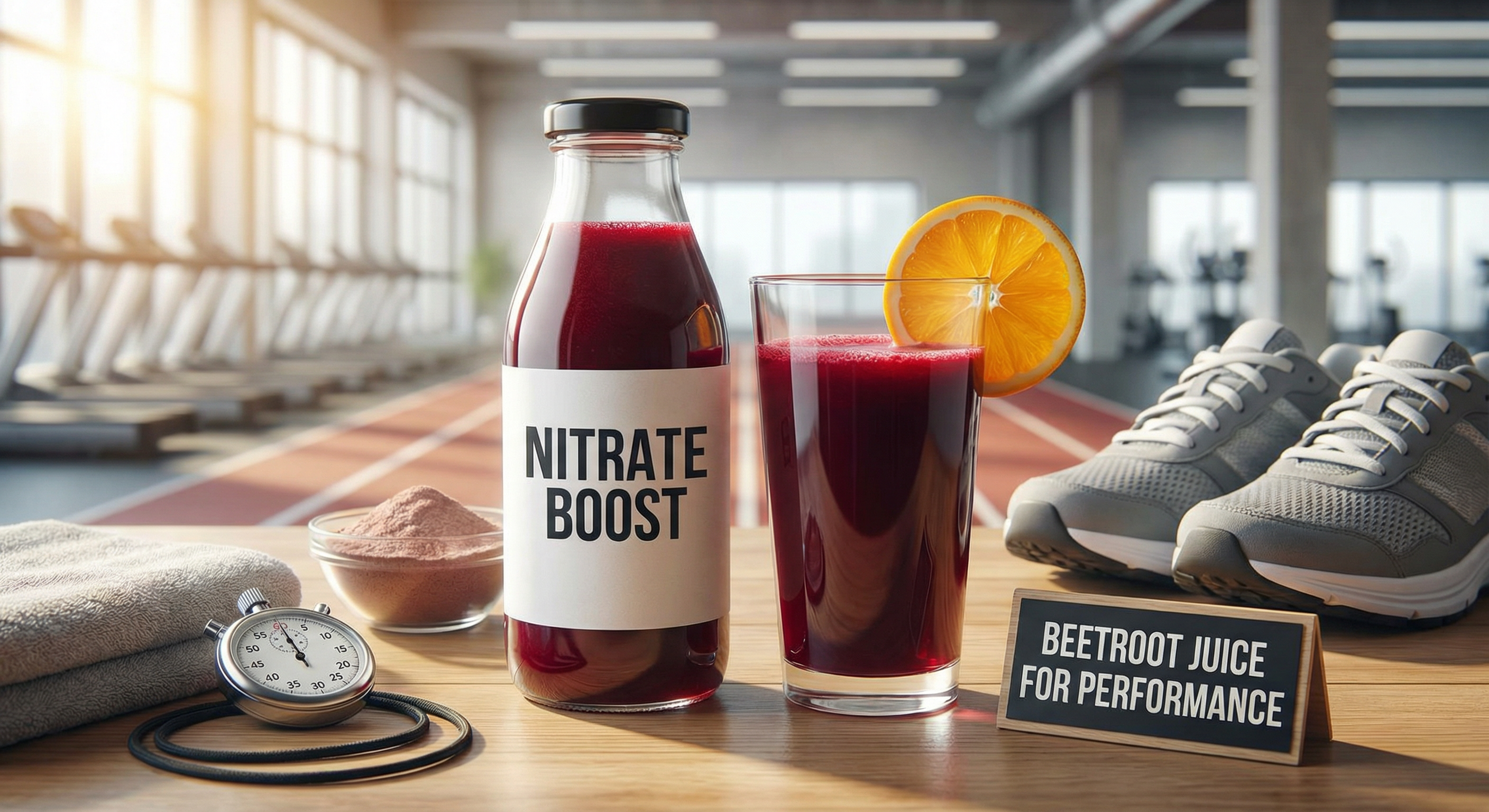
Beetroot juice has gained attention in sports nutrition for its nitrate content. Dietary nitrates are converted in the body to nitrite and then to nitric oxide (NO), which can improve blood flow, reduce the oxygen cost of exercise, and support endurance performance. As a sport doctor and someone who works with athletes, I see interest in using beetroot as a legal, food-based ergogenic aid. The evidence is promising for certain types of effort—especially sustained endurance and high-intensity intervals—but dosing, timing, and individual response matter. This guide summarises what nitrates do, how to use beetroot juice effectively, and what the research actually shows.
In this guide you will learn how dietary nitrates may support performance, optimal dosing and timing, who might benefit most, and how to combine beetroot with training and nutrition. For product comparison you can browse beetroot supplements and sports nutrition.
Why Nitrates Matter for Performance
Nitrates from food (beetroot, leafy greens, and some other vegetables) are absorbed and partly converted to nitrite in the mouth and gut. Nitrite can then be converted to nitric oxide, which dilates blood vessels, improves perfusion of working muscle, and may reduce the ATP cost of muscle contraction. In practice, this can mean better endurance, lower perceived exertion at a given intensity, and sometimes improved time-trial or time-to-exhaustion performance. The effect is most consistent in tasks lasting from a few minutes to an hour or more, and in well-trained athletes who have optimized other factors (training, sleep, nutrition).
What the Evidence Shows
Quality studies and meta-analyses show that acute or short-term nitrate supplementation (often as beetroot juice or concentrated nitrate) can improve time-trial performance, time to exhaustion, and reduce the oxygen cost of submaximal exercise in many but not all studies. The size of the effect is often modest (a few percent) but can be meaningful in competition. Response varies: some individuals respond strongly, others little. Factors that may influence response include baseline nitrate intake (already eating lots of vegetables), oral microbiome (nitrate-reducing bacteria), training status, and the type of exercise. Cessation of nitrate intake or antibacterial mouthwash can reduce the conversion of nitrate to nitrite and blunt the effect; so consistency and avoiding mouthwash around dosing may help.
Dosing and Timing
Most studies use nitrate doses equivalent to about 6–8 mmol nitrate (or roughly 400–500 mg nitrate from beetroot juice or concentrate). That often translates to 300–500 ml of beetroot juice or a concentrated shot, depending on product. Timing: nitrate levels in blood peak about 2–3 hours after ingestion, so many athletes take beetroot 2–3 hours before competition or key training. Some protocols use a loading phase (e.g. 5–6 days of daily nitrate) before an event; others use a single dose 2–3 hours before. Consistency in the hours before the event matters more than last-minute megadoses. Avoid mouthwash and very high doses (more is not always better; very high nitrate can cause GI upset or headache in some people).
Who Might Benefit Most
Athletes in endurance sports (cycling, running, rowing, swimming), team-sport players with repeated high-intensity efforts, and those doing time trials or sustained threshold efforts are the main groups studied. Benefits are less clear for very short sprints (seconds) or pure strength. If you already eat a lot of nitrate-rich vegetables, the added benefit of supplementation may be smaller. If you are new to nitrates, try a standard dose 2–3 hours before a hard session and note how you feel and perform; then refine timing and dose based on your response.
Safety and Side Effects
Dietary nitrates from vegetables and beetroot juice are generally considered safe at typical supplemental doses. Possible side effects include gastrointestinal discomfort, red or dark urine (harmless, from beet pigments), and in some people headache or flushing. Very high nitrate intake is not recommended; stick to evidence-based doses. People with low blood pressure or on certain medications should discuss nitrate supplementation with their doctor. Nitrate from food is different from nitrite in processed meats; we are talking about vegetable-source nitrate used as an ergogenic aid.
Practical Use: Before Competition and Training
For a key race or time trial: try a dose equivalent to 6–8 mmol nitrate 2–3 hours before, and avoid antibacterial mouthwash in the hours before. Use the same protocol in training first so you know how your gut and performance respond. For regular training, some athletes use beetroot on hard session days only; others use a loading phase before important events. Do not rely on beetroot to replace proper training, pacing, and nutrition; it is a potential edge when the basics are in place. Compare options in beetroot and performance supplements.
Beetroot vs Other Nitrate Sources
Beetroot juice and concentrate are the most studied; they also provide betalains (antioxidants) and other compounds. Leafy greens (spinach, arugula, kale) contain nitrates too, but amounts vary and achieving 6–8 mmol from greens alone would require large volumes. Concentrated nitrate salts or shots are used in research and are available as supplements; they allow precise dosing. For most athletes, beetroot juice or a quality concentrate is a practical choice. Choose products with stated nitrate content when possible.
Combining With Other Strategies
Beetroot works alongside good training, adequate carbohydrates around sessions, hydration, and sleep. It does not replace a taper, race nutrition, or pacing. Some athletes combine nitrate with caffeine (e.g. caffeine 1 hour before, beetroot 2–3 hours before); evidence for a strong additive effect is mixed, but both are legal and commonly used. Avoid stacking many new supplements at once; introduce beetroot, assess response, then consider other additions if needed.
When Results Are Mixed or Absent
Not everyone sees a clear performance boost. If you have tried standard dosing and timing without effect, consider: Are you already high in dietary nitrate from vegetables? Have you avoided mouthwash and given a consistent dose 2–3 hours before? Is the task you are testing (e.g. 5K, 20-min power) one that has shown benefit in studies? Sometimes a longer loading phase (5–7 days) is used for adaptation. If you still see nothing, nitrates may not be a major lever for you; focus on training, recovery, and other nutrition first.
Loading Phase: When and How to Use It
Some studies use a loading phase: daily nitrate (e.g. beetroot juice or concentrate) for 5–7 days before a key event. The idea is to raise baseline nitrate/nitrite and possibly improve conversion capacity. Not all research shows a clear advantage of loading over a single acute dose 2–3 hours before; results are mixed. If you want to try loading, use a standard dose (6–8 mmol nitrate equivalent) each day for 5–6 days, with the last dose 2–3 hours before the event. Keep the rest of your diet and routine consistent so you can judge the effect. Do not assume that more days or higher doses will help; evidence-based amounts are enough. After the event, you can stop or reduce to key sessions only; there is no need to take beetroot every day year-round unless you prefer it as part of your routine.
Common Mistakes With Beetroot and Nitrates
Taking beetroot too close to the start (e.g. 30 minutes before) is a mistake: nitrate/nitrite peaks at 2–3 hours, so last-minute dosing may not align with your effort. Using antibacterial mouthwash in the hours before a dose can reduce the conversion of nitrate to nitrite by oral bacteria and blunt the effect; avoid it when you want maximum benefit. Another error is expecting a huge boost: the effect is often a few percent, which can matter in a race but will not replace training or pacing. Do not megadose: very high nitrate intake can cause GI upset, headache, or flushing in some people; stick to 6–8 mmol equivalent. Finally, do not add beetroot at the same time as many other new supplements; introduce it alone, assess response, then consider other additions. That way you know whether nitrates are helping you.
Individual Response and How to Test
Response to dietary nitrate varies. To test whether beetroot helps you, pick a repeatable session (e.g. a 20-minute time trial, a set distance, or a threshold interval set) and do it twice: once with your standard nutrition and once with beetroot juice or concentrate at 6–8 mmol nitrate, 2–3 hours before. Keep training load, sleep, and other variables as similar as possible. Compare power, time, or perceived exertion. If you see a consistent improvement with beetroot, use it for key sessions and races; if not, you may be a non-responder or already getting enough nitrate from diet, and you can save the cost. Some athletes respond strongly, others minimally; there is no need to force it if the basics (training, sleep, carbs, recovery) are not yet optimized.
FAQ
How long before a race should I take beetroot?
Most protocols use 2–3 hours before the start so nitrate/nitrite levels are high during the effort. Test this in training first.
Can I take beetroot every day?
Yes. Some athletes use daily nitrate (e.g. juice or concentrate) as part of a loading phase before events; others use it only on key session days. Daily use at evidence-based doses is generally safe.
Does beetroot juice need to be fresh?
Concentrated products and shelf-stable juices can provide effective nitrate doses if the nitrate content is preserved. Check the label for nitrate amount or equivalent.
Summary: Nitrate Dosing and Timing at a Glance
Dose: about 6–8 mmol nitrate (e.g. 300–500 ml beetroot juice or equivalent concentrate). Timing: 2–3 hours before key sessions or competition so nitrate/nitrite levels are high during the effort. Avoid antibacterial mouthwash in the hours before dosing; consistency and timing matter more than megadoses. Test in training first; response varies. Use alongside proper training, nutrition, and recovery—not as a substitute. Beetroot and nitrate supplements are generally safe at typical doses; discuss with a doctor if you have low blood pressure or take relevant medications. Get the basics right first (training, sleep, carbs, pacing), then consider nitrate support as a potential edge for endurance and time trials. Choose products with stated nitrate content when possible; concentrated shots and shelf-stable juices can be effective if the nitrate is preserved. Red or dark urine after beetroot is harmless and due to beet pigments. If you see no benefit after a few trials with correct timing and dose, focus on other levers (training, recovery, nutrition) rather than increasing nitrate dose. Endurance athletes in cycling, running, rowing, and swimming are the main groups where nitrate supplementation has been studied; team-sport players with repeated high-intensity efforts may also benefit. Very short sprints (seconds) or pure strength work show less consistent benefit. Use beetroot as one part of a full race or training plan that includes proper tapering, fuelling, and pacing—not as a substitute for the fundamentals. When used with the right dose, timing, and expectations, beetroot juice can be a useful addition to an athlete's nutrition plan. Recap: dose about 6–8 mmol nitrate (e.g. 300–500 ml juice or equivalent concentrate), 2–3 hours before key sessions or competition. Avoid antibacterial mouthwash in the hours before dosing; test in training first. Response varies; not everyone sees a clear boost. Use beetroot alongside proper training, fuelling, and recovery—not as a substitute. At typical doses beetroot and nitrate supplements are generally safe; discuss with a doctor if you have low blood pressure or take relevant medications. Get the basics right first, then consider nitrate support as a potential edge for endurance and time trials.
Takeaways
- Dietary nitrates from beetroot (and other vegetables) can support endurance and reduce the oxygen cost of exercise; effects are most consistent for sustained efforts and time trials.
- Dose: about 6–8 mmol nitrate (e.g. 300–500 ml juice or equivalent concentrate), 2–3 hours before key sessions or competition.
- Avoid antibacterial mouthwash around dosing; consistency and timing matter more than megadoses.
- Response varies; test in training first. Use alongside proper training, nutrition, and recovery—not as a substitute.
- Beetroot and nitrate supplements are generally safe at typical doses; discuss with a doctor if you have low blood pressure or take relevant medications.
Beetroot juice can be a useful addition to an athlete's nutrition plan when used with the right dose, timing, and expectations. Get the basics right first, then consider nitrate support as a potential edge.