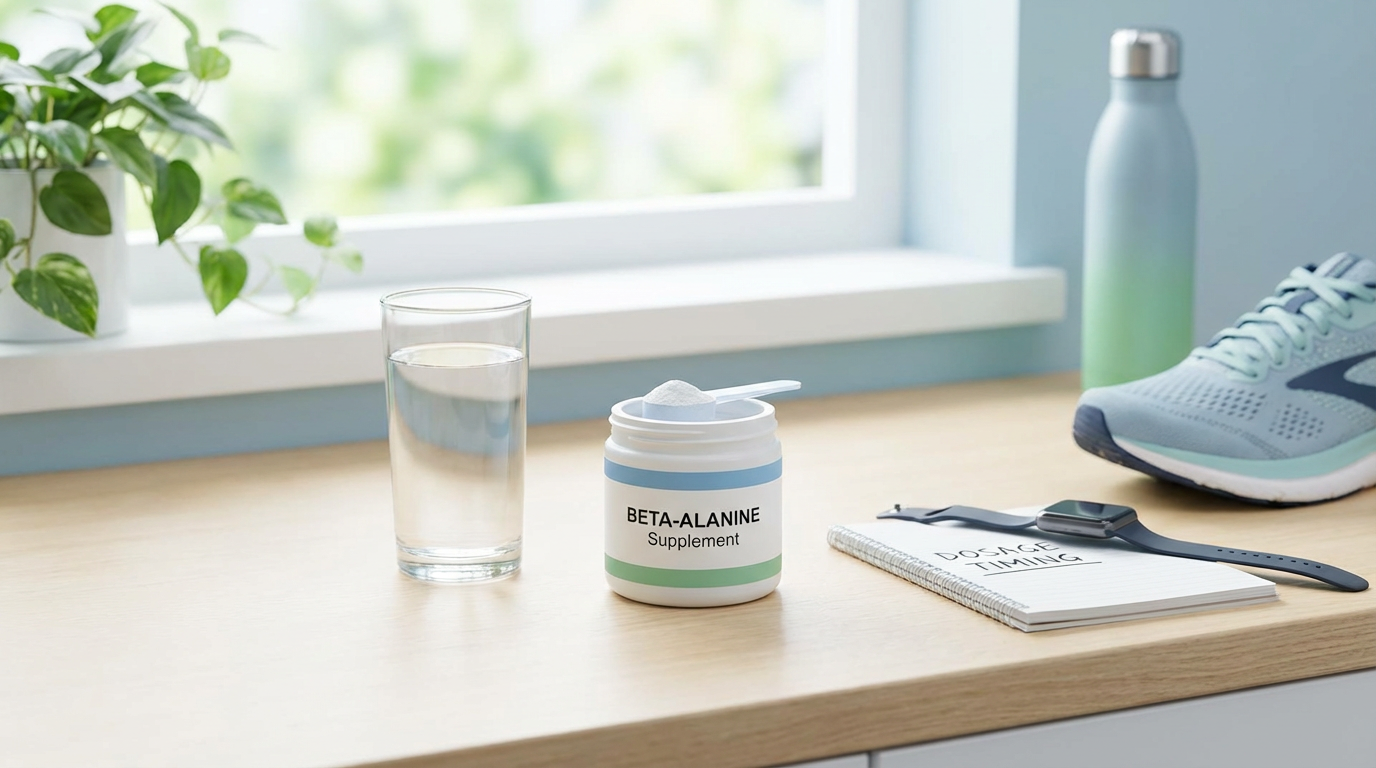
Beta-alanine is one of the best-supported performance supplements for high-intensity efforts lasting roughly 1–4 minutes. It increases muscle carnosine, which buffers hydrogen ions and can delay fatigue when you push hard. As a fitness trainer, I often get questions about how much to take, when to take it, and whether a loading phase is necessary. This guide covers evidence-based dosing, timing relative to training, and practical tips so you can use beta-alanine effectively without guesswork.
For product options you can browse beta-alanine supplements and sports nutrition on iHerb. Choose products with clear labeling and, if you are subject to drug testing, consider third-party certified options.
Why dosage and timing matter
Beta-alanine does not work instantly. It is taken up by muscle and converted into carnosine over time. Muscle carnosine levels rise with consistent daily intake; the effect on performance builds over weeks, not hours. So the right dose and timing are about building and maintaining carnosine rather than taking a single “pre-workout” hit. Too little and you may not see a benefit; too much and you may get more tingling (paresthesia) without extra performance gain.
Evidence-based dosing: total daily amount
Research consistently uses 3.2–6.4 g per day of beta-alanine, often split into smaller doses (e.g., 1.6 g two times per day or 800 mg four times per day). The upper end (around 6.4 g/day) is often used in loading phases; 3.2–4 g/day is common for maintenance. Going above 6.4 g/day does not reliably add benefit and increases the chance of paresthesia (tingling, usually harmless but noticeable).
Start at the lower end (e.g., 3.2 g/day split into 2–4 doses) and stay consistent for at least 4 weeks before judging effect. Many people use 4–5 g/day as a practical target. Products like beta-alanine powder or sustained-release tablets make it easy to hit these doses; follow label instructions and match total daily intake to the ranges above.
Loading phase vs maintenance
Loading (4–6 weeks): A common approach is to take 4–6 g/day split into 2–4 doses for 4–6 weeks to raise muscle carnosine quickly. After that, a lower maintenance dose (e.g., 2–3.2 g/day) may help maintain levels, though some people simply continue at 3.2–4 g/day year-round.
Maintenance: If you skip loading and go straight to 3.2–4 g/day, carnosine will still rise, but more slowly. Either way, consistency matters more than a short burst of high dose. Plan for at least 4 weeks of consistent use before expecting a clear performance effect.
Timing: when to take beta-alanine
Because beta-alanine works by increasing muscle carnosine over time, exact timing of each dose matters less than total daily intake and consistency. Splitting the daily amount into 2–4 doses (e.g., with meals or at fixed times) keeps blood levels more stable and may reduce tingling compared with one large dose. Some people take one dose with their pre-workout meal or 30–60 minutes before training; that is fine, but the benefit comes from sustained carnosine elevation, not from that single dose alone.
Practical approach: take 1–1.6 g per serving, 2–4 times per day, at times that are easy to remember (e.g., morning, lunch, pre-workout, evening). Avoid taking a huge single dose (e.g., 4 g at once) to minimize paresthesia.
Paresthesia (tingling): what it is and how to handle it
Many users feel a harmless tingling or flushing sensation, usually in the face, neck, or hands, 15–30 minutes after a dose. This is paresthesia and is linked to the size of the dose: larger single doses tend to cause it more. It usually fades within 60–90 minutes. To reduce it, split the daily total into more, smaller doses (e.g., 800 mg four times per day instead of 1.6 g twice). Sustained-release forms may also reduce tingling by spreading absorption. The tingling is not a sign of better effectiveness; it is just a side effect of high peak blood levels.
How long until you see results
Muscle carnosine increases over 2–4 weeks of consistent intake and can plateau after 4–6 weeks at an adequate dose. Performance benefits (e.g., more reps, longer time to fatigue, better output in 1–4 minute efforts) typically show up after at least 4 weeks. Do not expect an immediate boost on day one. Plan for a 4–6 week block of consistent use before evaluating.
Who benefits most
Beta-alanine is most relevant for activities that rely on the glycolytic system and produce a lot of hydrogen ions: high-intensity intervals, sprint repeats, rowing, swimming sprints, and resistance training with short rest. It is less relevant for pure endurance (e.g., long steady runs) or very short, purely phosphagen efforts (e.g., a single max lift). If your main training is 1–4 minute high-intensity efforts, beta-alanine is a strong candidate.
Combining with other supplements
Beta-alanine is often stacked with creatine; both are well supported and work by different mechanisms. Creatine supports phosphagen replenishment; beta-alanine supports buffering during sustained high-intensity work. There is no need to take them at the same time of day. Sodium bicarbonate (baking soda) is another buffering agent; stacking with beta-alanine is possible but can increase GI upset and tingling, so start with one at a time.
Safety and side effects
At recommended doses (3.2–6.4 g/day), beta-alanine is considered safe for healthy adults. The main side effect is paresthesia; reducing single-dose size or using sustained-release usually manages it. There is no evidence that beta-alanine causes harm to kidneys or liver at these doses. If you have a medical condition or take medications, check with your doctor before starting. Do not use in pregnancy or breastfeeding without medical advice.
Food sources and baseline carnosine
Carnosine is found in meat and fish; beta-alanine is the rate-limiting precursor for carnosine synthesis in muscle. People who eat little or no meat typically have lower baseline muscle carnosine and may see a relatively larger benefit from supplementation. Even so, food alone does not provide enough beta-alanine to significantly raise muscle carnosine for performance; supplementation is the practical approach. If you are vegetarian or vegan, beta-alanine is often one of the few evidence-based performance supplements that may give a noticeable edge in high-intensity efforts.
Common mistakes: what to avoid
Taking one huge dose right before training in the hope of an immediate boost does not work; beta-alanine works by building carnosine over weeks. Skipping days or varying dose heavily makes it harder to reach and maintain effective carnosine levels. Expecting results after one week is unrealistic; plan for at least 4 weeks. Using a dose far above 6.4 g/day does not add benefit and increases tingling. Ignoring paresthesia and taking a single large dose anyway can make training uncomfortable; split doses instead. Finally, do not drop beta-alanine and other variables (training, sleep, diet) at the same time when testing — you will not know what drove any change.
Sustained-release vs regular powder
Sustained-release (SR) forms release beta-alanine more slowly into the bloodstream, which can reduce the peak concentration that triggers paresthesia. Some users find SR more comfortable, especially when taking larger daily totals. Regular powder is often cheaper and easier to split into small doses throughout the day. Both can work; choose based on cost, convenience, and whether tingling is a problem for you. Whatever form you use, match your total daily intake to the 3.2–6.4 g/day range and give it at least 4 weeks.
Relevance for different sports and training styles
Beta-alanine is most relevant for repeated high-intensity efforts: rowing, swimming sprints, track cycling, middle-distance running (e.g., 800 m), combat sports rounds, CrossFit-style metcons, and resistance training with short rest (30–90 seconds). It is less relevant for long steady-state endurance (e.g., marathon running at steady pace) or single maximal lifts. If your training mix includes both endurance and high-intensity blocks, you may still benefit during the high-intensity phases; there is no need to stop beta-alanine in the endurance block, but the performance gain will show mainly when you push in the 1–4 minute range.
Quick reference: dosage and timing
- Daily dose: 3.2–6.4 g/day (4–5 g/day is a practical target for many).
- Loading: 4–6 g/day for 4–6 weeks, then 2–3.2 g/day maintenance or continue 3.2–4 g/day.
- Split: 2–4 doses per day (e.g., 1–1.6 g per dose) to reduce tingling and keep intake consistent.
- Timing: Total daily amount and consistency matter more than exact clock time; spread doses across the day.
- Minimum period: At least 4 weeks of consistent use before judging performance effect.
Stick to these guidelines and give it time; beta-alanine is one of the few supplements with strong evidence for improving high-intensity performance when dose and consistency are right. If you are new to beta-alanine, start with 3.2 g/day split into two or three doses (e.g., 1.6 g with breakfast and 1.6 g with lunch or dinner). After 2 weeks, if you have no issues with tingling, you can increase to 4 g/day or add a loading phase at 4–6 g/day for 4–6 weeks. Keep a simple log of your daily intake and training so that after 4–6 weeks you can assess whether you are doing more work in the 1–4 minute range or recovering better between sets. Do not stack with several other new supplements at once; evaluate beta-alanine first, then consider adding creatine or other evidence-based options if needed.
What if you miss a day or take a break
Muscle carnosine declines slowly when you stop supplementing; it does not drop to baseline overnight. If you miss a day, resume your usual dose the next day; no need to double up. If you take a longer break (e.g., several weeks off), carnosine levels will gradually fall and you may need another 4–6 week block to rebuild. Many athletes use beta-alanine year-round at maintenance (2–3.2 g/day or 3.2–4 g/day) once they have completed loading, so consistency is easier. There is no strong evidence that you must cycle off beta-alanine; the main reason to take a break is personal preference or to reassess whether you still need it. Some people prefer to use beta-alanine only during high-intensity training phases and drop it during pure endurance or recovery blocks; that is fine. The key is to give any protocol at least 4 weeks of consistent use before judging so that carnosine has time to build. If you are stacking with creatine, take both at their recommended daily doses; you do not need to take them at the same time of day. Splitting beta-alanine into three or four smaller doses (e.g., 800 mg to 1 g each) is often more comfortable than two larger doses and can reduce or eliminate tingling for most users. In summary: aim for 3.2–6.4 g/day (4–5 g/day is a practical target), split into 2–4 doses, and give at least 4 weeks of consistent use before judging performance. Beta-alanine is one of the few supplements with strong evidence for high-intensity efforts in the 1–4 minute range when dose and consistency are right. Vegetarians and vegans often have lower baseline carnosine and may see a relatively larger benefit; if you do not eat meat or fish, beta-alanine is especially worth considering for high-intensity training. Always pair supplementation with adequate training, recovery, and nutrition — beta-alanine supports performance but does not replace the fundamentals. Before your first competition or test, complete at least 4 weeks of consistent intake so that muscle carnosine is built up; then compare work output (reps, time, power) to see if beta-alanine is helping. If tingling is a concern, use sustained-release products or split the daily dose into four smaller servings (e.g., 800 mg each).
Doping and third-party certification
Beta-alanine is not banned by WADA or major sports organizations; it is a legal ergogenic aid. If you are subject to drug testing (collegiate, professional, or other), choose products that are third-party certified for banned substances (e.g., NSF Certified for Sport, Informed Sport) to avoid contamination. Contaminated supplements have caused positive tests in the past; certification reduces that risk. Store your supplement in a cool, dry place and use by the expiration date. If you travel with powder, keep it in original packaging to avoid confusion at borders or with anti-doping officials.