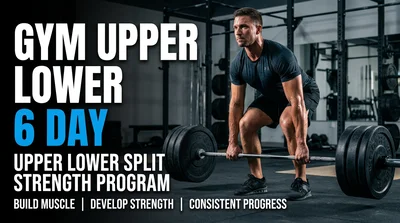
What Is an Upper/Lower Split?
An upper/lower split divides your training into upper-body days (chest, back, shoulders, arms) and lower-body days (quads, hamstrings, glutes, calves). You train each half twice per week in this 4-week programme, so each muscle group gets hit twice with time to recover. This balance is popular because it allows enough volume for growth and strength without excessive frequency or very long sessions. As a fitness coach, I recommend it for lifters who have outgrown full-body three times per week and want more focus per muscle group without jumping to five or six days.
Why Four Weeks?
Four weeks is a solid block to establish the pattern and see progress. You can run it back-to-back for 8 or 12 weeks, or use it as a stepping stone to a different split (e.g. push/pull/legs) later. The programme has two phases: weeks 1–2 (Upper/Lower A and B) focus on building the push and pull base; weeks 3–4 add progression—slightly heavier weights or more reps—so you finish the block stronger than you started. Many lifters add 2.5–5 kg to main lifts over the four weeks or add a rep per set when weight is held constant.
Session Structure
You will have four sessions per week: Upper A, Lower A, Upper B, Lower B. Upper A might emphasise horizontal push (e.g. bench, push-ups) and horizontal pull (rows); Upper B might emphasise vertical push (overhead press) and vertical pull (pull-ups or lat pulldowns). Lower days can alternate between squat-dominant and hinge-dominant (e.g. deadlifts, RDLs) so both quads and posterior chain get attention. Keep sessions to roughly 45–60 minutes including warm-up; quality and consistency beat marathon sessions. Put compound lifts first and isolation or accessory work after.
Sample Week and Exercise Selection
Monday Upper A: bench press 3×8–10, barbell row 3×8–10, overhead press 2×10, face pull 2×15. Tuesday Lower A: squat 3×8–10, Romanian deadlift 3×8–10, leg curl 2×12, calf raise 2×15. Thursday Upper B: overhead press 3×8–10, lat pulldown or pull-up 3×8–10, incline dumbbell press 2×10, biceps/triceps 2×12 each. Friday Lower B: deadlift 3×6–8, leg press or lunge 3×10, leg extension 2×12, plank. Adjust exercises for equipment and preference; keep the push/pull and squat/hinge balance.
Rep Ranges and Intensity
Use moderate rep ranges (e.g. 8–12 for most exercises, 6–10 for main compounds if you prefer) so you can balance hypertrophy and strength. Rest 90–120 seconds between heavy compound sets and 60–90 seconds for isolation work. Choose weights that allow you to complete the target reps with good form; the last rep should be challenging but not necessarily to failure every set. Progressive overload over the four weeks—add a little weight or a rep when you can—will drive results. If you hit failure or form breaks down, note it and repeat the same weight next time or add a rep before adding load.
Recovery and Balance
With four sessions per week, you have a rest day or two between repeat sessions for the same muscle group. Use rest days for light activity (walking, stretching) or complete rest. Sleep and nutrition support recovery; if you feel run down, consider an extra rest day rather than pushing through. The upper/lower split is sustainable precisely because it balances stimulus and recovery. Aim for 7–8 hours of sleep and sufficient protein (e.g. 1.6–2.2 g per kg body weight) to support muscle repair. Protein and creatine can help meet targets when whole foods fall short; they do not replace a balanced diet.
Customisation
If you do not have access to barbells, use dumbbells, kettlebells, or resistance bands for similar movement patterns. Substitute exercises as needed for equipment or limitations—for example, leg press or goblet squats for barbell squats, or inverted rows for barbell rows. The principle stays the same: push and pull for upper body, squat and hinge for lower body, with progressive overload over the block. If you have shoulder or back issues, swap exercises (e.g. machine press instead of barbell, or single-arm row) and keep volume and progression logic.
Common Mistakes
Doing too much per session (e.g. six or seven exercises) extends sessions and can compromise recovery. Skipping rest days or adding a fifth day too soon leads to fatigue. Using the same weight for four weeks without attempting to add load or reps leaves gains on the table. Ignoring upper/lower balance (e.g. all push and no pull) increases injury risk and creates imbalance. Not warming up or cooling down can increase stiffness and injury risk. Stick to the four-session structure and progress gradually.
When to Deload or Change
If you feel chronically fatigued or performance drops for two weeks in a row, take a deload week: reduce weight by 30–40% or cut one set per exercise. After 8–12 weeks of upper/lower, some lifters switch to push/pull/legs or another split for variety. The 4-week block can be repeated with slightly higher starting weights or different exercise variations. Listen to your body and adjust rather than pushing through persistent fatigue.
Evidence and Practical Tips
Research on resistance training supports training each muscle group at least twice per week for hypertrophy and strength when volume is equated. The upper/lower split fits this model. Quality matters: prioritise sleep, protein, and technique. Many lifters use protein powder and creatine to support training; use them as part of a balanced diet. If you have health conditions or take medications, consult a healthcare provider before starting. This guide is for education and does not replace advice from a coach or doctor.
Summary
- Split: Upper A, Lower A, Upper B, Lower B—four sessions per week.
- Phases: Weeks 1–2 base; weeks 3–4 progression.
- Recovery: Rest 90–120 s between heavy sets; use rest days wisely.
- Progress: Add weight or reps over the four weeks; track main lifts.
- Protein and creatine can support recovery when diet allows; prioritise whole foods and sleep.
This 4-week gym upper/lower split gives you a clear, balanced structure for strength and muscle with room to progress and repeat.