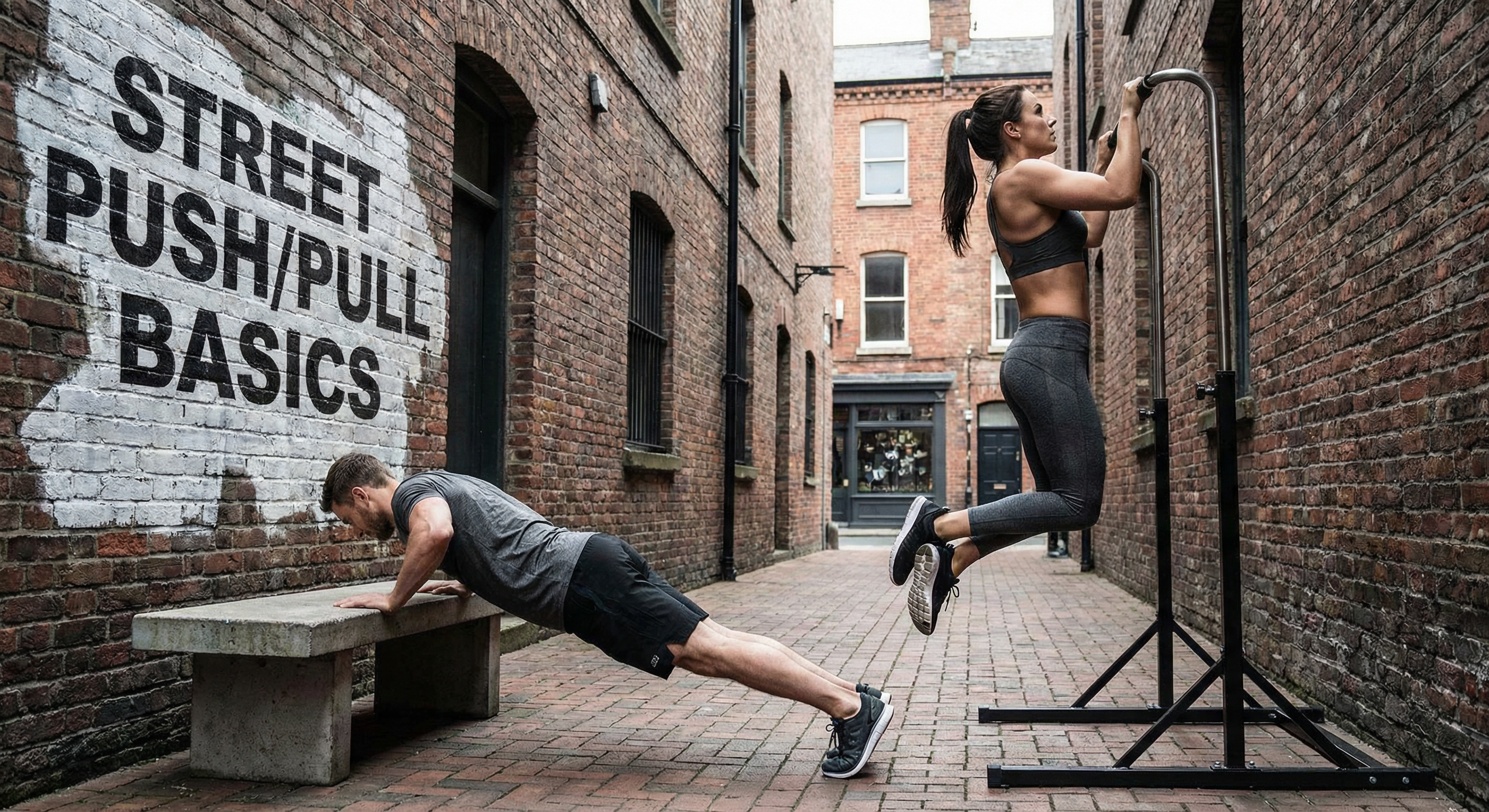
What Is a Push/Pull Split?
In calisthenics, push exercises work the muscles that push the body away from the ground or a bar (chest, shoulders, triceps) — push-ups, dips, pike push-ups. Pull exercises work the muscles that pull the body toward the bar or object (back, biceps) — pull-ups, chin-ups, rows. Splitting your training into push and pull days lets you train each pattern with enough volume and recovery. This 4-week programme alternates push- and pull-focused sessions so your upper body gets balanced development with minimal equipment.
Why Four Weeks?
Four weeks is enough to learn or refine the main movements and build a habit. You can repeat the programme for another block or progress to harder progressions (e.g. archer push-ups, weighted pull-ups) later. The programme has two phases: weeks 1–2 focus on building a base with push-ups and dips (push) and pull-ups or rows (pull); weeks 3–4 add progression — more reps, harder progressions, or shorter rest — so you finish stronger than you started.
Equipment and Space
You need something to push from (floor, parallettes, or bars for dips) and something to pull from (pull-up bar, tree branch, or suspension trainer for rows). A playground, home pull-up bar, or gym with a bar and dip station is enough. No weights required — bodyweight and leverage provide the load. If you cannot do full pull-ups yet, use band-assisted pull-ups, negatives, or inverted rows and build up.
Push Day Basics
Push sessions centre on push-ups and dips (or knee push-ups and bench dips if you are building up). Add pike push-ups or handstand push-up progressions if you want more shoulder work. Aim for 3–4 sets per exercise in a rep range that is challenging but allows good form — for example, 8–15 reps per set for push-ups, 5–12 for dips. Rest 60–90 seconds between sets. Focus on full range of motion and controlled tempo rather than speed.
Pull Day Basics
Pull sessions centre on pull-ups (or chin-ups) and horizontal rows (inverted rows, suspension rows). If pull-ups are hard, use bands, negatives, or more row volume until you can do at least a few full reps. Aim for 3–4 sets per exercise, again in a range that is challenging but clean — e.g. 5–10 pull-ups, 8–15 rows per set. Rest 60–90 seconds. Quality and consistency matter more than maxing out every set.
Recovery and Frequency
Three sessions per week gives you roughly one push, one pull, and one more of either, with rest days in between. Do not add too many extra sessions early on — recovery is when strength and muscle adapt. Sleep and nutrition support progress; if you feel overly sore or tired, take an extra rest day or reduce volume slightly. The programme is designed to be sustainable so you can repeat or progress after 4 weeks.
Summary
- Split: Push (push-ups, dips) and pull (pull-ups, rows) — three sessions per week.
- Phases: Weeks 1–2 base; weeks 3–4 progression.
- Equipment: Pull-up bar and dip station (or alternatives); no weights needed.
- Progress: Add reps or harder progressions over the block; prioritise form.
This 4-week street push/pull basics programme gives you a clear structure for a balanced, equipment-minimal upper body using only bodyweight.
Practical Tips
Follow evidence-based dosing; consistency usually matters more than a single large dose. Prioritise sleep, nutrition, and stress management. If you take other supplements or medications, check for interactions. When in doubt, seek professional advice. Compare quality supplements at iHerb.
Practical Tips
Follow evidence-based dosing; consistency usually matters more than a single large dose. Prioritise sleep, nutrition, and stress management. If you take other supplements or medications, check for interactions. When in doubt, seek professional advice. Compare quality supplements at iHerb.
Practical Tips
Follow evidence-based dosing; consistency usually matters more than a single large dose. Prioritise sleep, nutrition, and stress management. If you take other supplements or medications, check for interactions. When in doubt, seek professional advice. Compare quality supplements at iHerb.
Practical Tips
Follow evidence-based dosing; consistency usually matters more than a single large dose. Prioritise sleep, nutrition, and stress management. If you take other supplements or medications, check for interactions. When in doubt, seek professional advice. Compare quality supplements at iHerb.
Practical Tips
Follow evidence-based dosing; consistency usually matters more than a single large dose. Prioritise sleep, nutrition, and stress management. If you take other supplements or medications, check for interactions. When in doubt, seek professional advice. Compare quality supplements at iHerb.
Practical Tips
Follow evidence-based dosing; consistency usually matters more than a single large dose. Prioritise sleep, nutrition, and stress management. If you take other supplements or medications, check for interactions. When in doubt, seek professional advice. Compare quality supplements at iHerb.
Practical Tips
Follow evidence-based dosing; consistency usually matters more than a single large dose. Prioritise sleep, nutrition, and stress management. If you take other supplements or medications, check for interactions. When in doubt, seek professional advice. Compare quality supplements at iHerb.