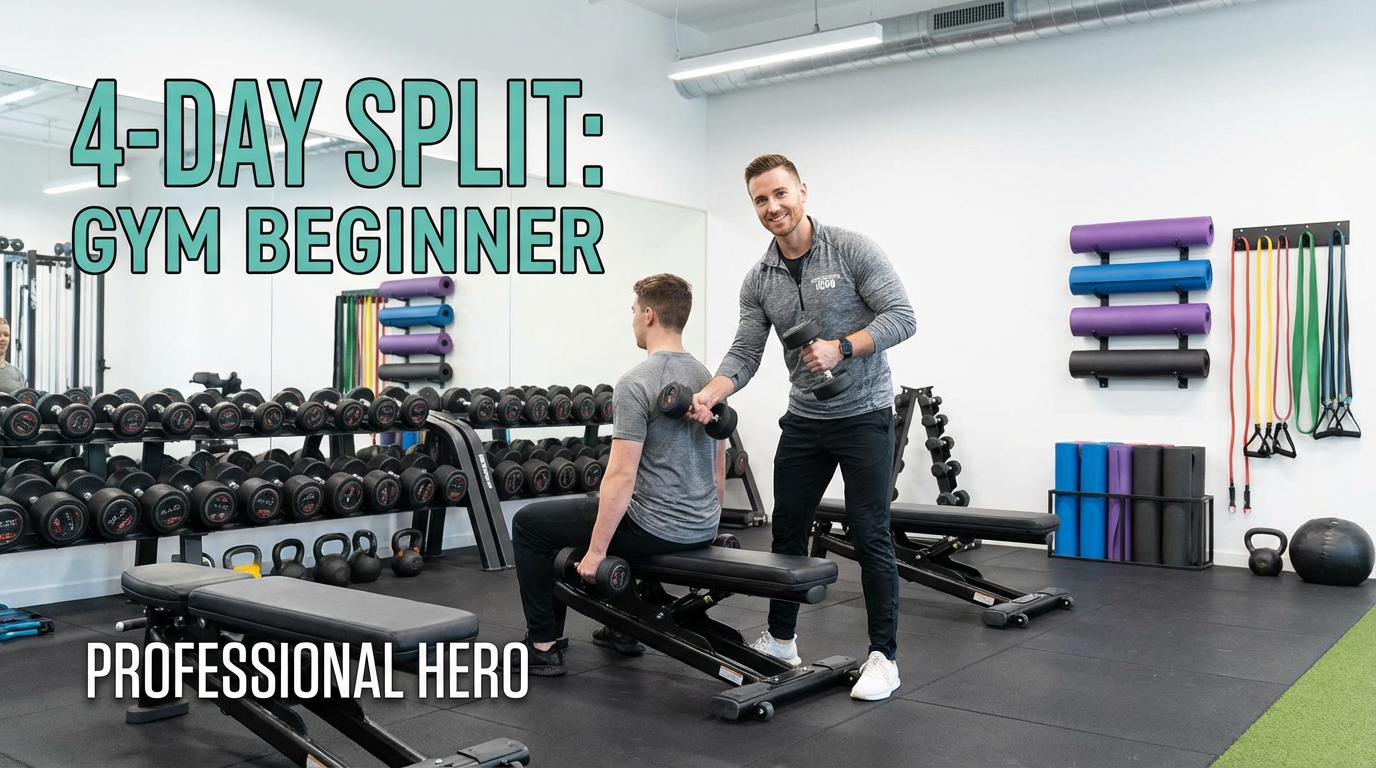
What Is a Beginner 4-Day Split?
A 4-day split divides your weekly training into four sessions, typically two upper-body days and two lower-body days (upper/lower). Each muscle group is trained twice per week, which supports both strength and muscle growth while keeping sessions focused and manageable. For beginners who have already built a base on a 3-day full-body programme (or who can commit to four days from the start), a 4-day upper/lower split is a logical next step: more frequency per muscle group without the complexity of a 5-day bro split. This guide covers structure, exercise selection, volume, progression, and recovery so you can run the programme effectively.
Who It Is For
This split suits people who can train four days per week and have at least a few months of consistent training or the ability to learn main lifts with good form. If you are brand new to the gym, starting with 3-day full-body is often simpler; once you are comfortable with squat, hinge, push, and pull patterns and can recover well, moving to 4 days can add volume and frequency. If you have only three days available, stay on full-body or run the 4-day split with one day dropped (you will still get each muscle twice in two weeks). Recovery capacity, sleep, and nutrition matter: do not add a fourth day if it means skipping sleep or burning out.
Structure of the Week
Classic layout: Day 1 Upper, Day 2 Lower, Day 3 rest, Day 4 Upper, Day 5 Lower, Day 6–7 rest. You can swap the order (e.g. Lower, Upper, rest, Lower, Upper) to fit your schedule. The key is that each muscle group is hit twice with at least one rest day between similar sessions. Sessions usually last 45–60 minutes. On upper days you do pressing (chest, shoulders) and pulling (back, biceps); on lower days you do squat and hinge patterns plus any leg assistance (e.g. leg curl, leg extension).
Upper Day: Exercises and Volume
Each upper day should include horizontal push (bench or push-up variation), vertical or horizontal pull (row, pulldown, or pull-up), and overhead press or variation. Add 1–2 exercises for rear delts, biceps, or triceps as needed. Aim for about 3–4 sets per main exercise in the 6–12 rep range; total working sets per muscle group per week (across both upper days) can be in the 10–16 range. Do not pack too many exercises into one session; 5–7 movements per upper day is enough. Rotate variations (e.g. incline bench one day, flat the other) to spread stimulus and avoid overuse.
Lower Day: Exercises and Volume
Each lower day should include a squat (back squat, front squat, or leg press) and a hinge (deadlift or Romanian deadlift). You can do squat emphasis on one lower day and deadlift emphasis on the other, or balance both. Add leg curl and/or leg extension for 2–3 sets each if desired; calf work is optional. Again, 3–4 sets per main lift in the 6–10 rep range; total weekly sets for quads and hamstrings in the 10–14 range per muscle group is a good target for beginners. Warm up properly and prioritise form over weight.
Sets, Reps, and Progression
Use 3–4 sets of 6–12 reps on main lifts. When you complete all sets and reps with good form, add a small amount of weight (2.5 kg upper, 5 kg lower) the next week. This is linear or step progression. Leave 1–2 reps in reserve on most sets so you are not failing every week. When progress stalls, take a deload week (lighter loads or fewer sets) and then resume. Do not jump weight too quickly; consistency and technique matter more than the number on the bar.
Recovery and Nutrition
With four sessions per week, recovery is important. Aim for 7–9 hours of sleep, adequate protein (1.6–2.0 g per kg body weight), and enough calories to support your goal. Hydration and meal timing around training can help. Supplements like protein and creatine can support strength and recovery but do not replace diet and sleep. See sports nutrition on iHerb for options. Use the two rest days for light activity or full rest; do not turn them into extra heavy sessions.
Common Mistakes
Doing too much volume per session leads to fatigue and poor recovery; keep total sets per muscle per week in a reasonable range. Neglecting one side of the body (e.g. only pushing and not pulling) causes imbalance; balance push and pull on upper days. Skipping warm-ups or jumping to heavy weights increases injury risk. Not deloading when progress stalls can lead to plateaus and burnout. Finally, do not switch to a 5-day split too soon; build a solid base on 4 days first.
When to Move to a Different Programme
When linear progression on the main lifts slows and you have run the 4-day split consistently for several months, you can consider a more advanced programme (e.g. 5/3/1, or a 4-day upper/lower with periodisation). There is no fixed timeline; some people stay on a simple 4-day split for a year or more. Listen to your body and your goals; the 4-day split is a versatile structure that can support both strength and hypertrophy for a long time.
Summary
- A 4-day split typically means two upper and two lower days; each muscle group is trained twice per week.
- Suits beginners who have a base or can learn main lifts and recover from four sessions.
- Upper days: push, pull, press; lower days: squat and hinge; 3–4 sets of 6–12 reps, progress by adding weight.
- Prioritise sleep, protein, and calories; use deloads when progress stalls.
- Balance volume and recovery; do not add a fifth day until the 4-day split is running well.