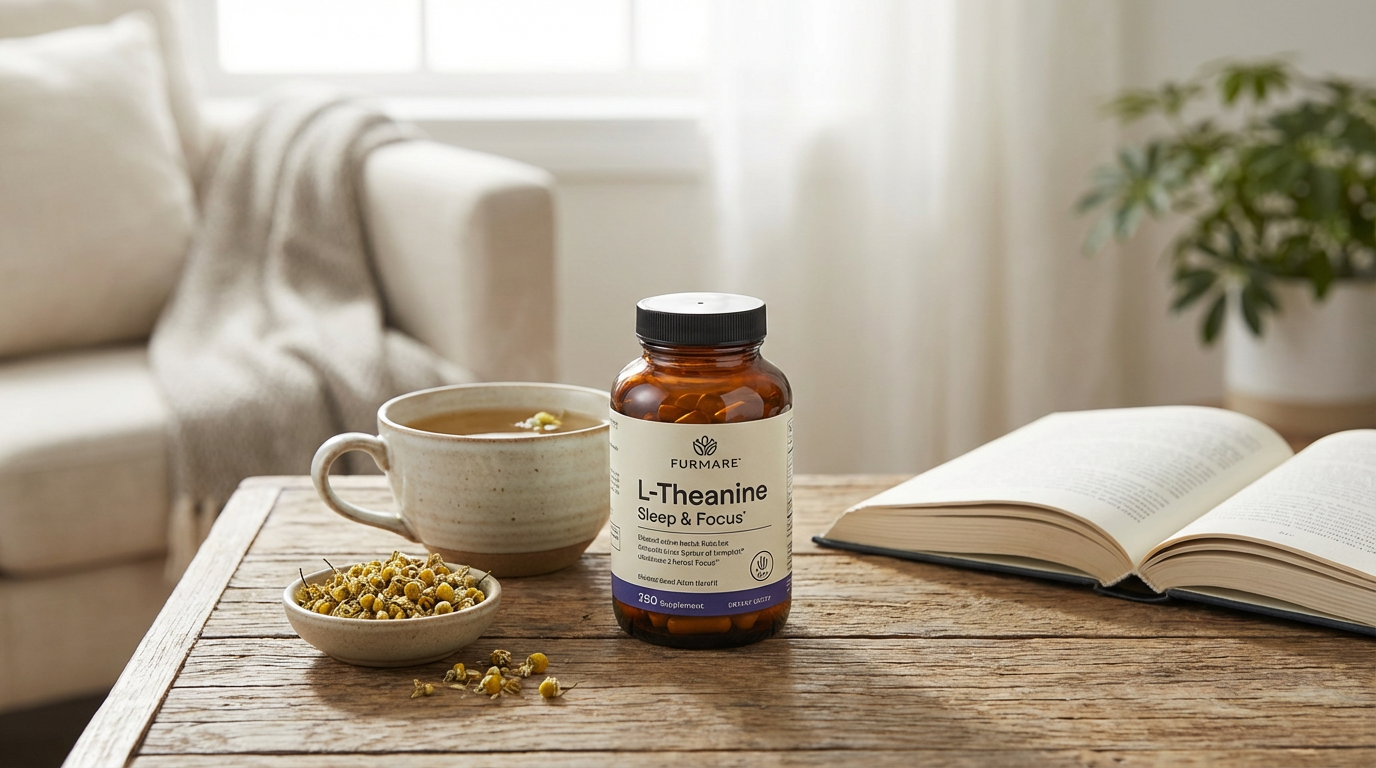
What Is L-Theanine?
L-theanine is an amino acid found mainly in tea (especially green tea). It supports relaxation without drowsiness and may improve focus and sleep quality when taken alone or with caffeine. It crosses the blood–brain barrier and can modulate brain activity, which explains why many people use it for both daytime concentration and evening wind-down. Quality L-theanine supplements are widely available; choose brands with clear dosing and third-party testing when possible.
How L-Theanine Works
L-theanine affects several neurotransmitter systems: it may increase GABA, serotonin, and dopamine in certain brain regions, which explains its relaxing yet focusing effect. Studies suggest possible improvements in attention and reduced subjective stress at 200–400 mg; for sleep, 100–200 mg about an hour before bed is common. Response depends on dose and individual sensitivity; some people notice effects from as little as 100 mg. It is not sedating in the classic sense — many take it in the morning with coffee to smooth caffeine jitters and sustain attention.
Sleep and Relaxation
When taken in the evening, L-theanine may support easier falling asleep and deeper sleep through a mild relaxing effect, without strong sedation. It does not replace sleep hygiene (consistent schedule, dim lighting, limiting screens); it can complement it. A typical dose for sleep is 100–200 mg thirty to sixty minutes before bed. Regular use for several weeks is safe in most studies; for ongoing insomnia, consultation with a doctor remains important. You can pair it with magnesium or low-dose melatonin in a sleep stack; follow product labels.
Evidence Base: What Research Shows
Randomised controlled trials of L-theanine and sleep or cognition show mixed but generally promising results. In several studies, 200–400 mg L-theanine taken about an hour before bed was associated with improved subjective sleep quality, shorter time to fall asleep, and fewer nighttime awakenings in healthy adults. Effects were moderate: not all participants reported clear improvement, which is typical for natural compounds with mild action. Meta-analyses point to possible increases in alpha-brain activity and reductions in stress markers; head-to-head comparisons with placebo over long-term use for sleep are still limited. Safety of L-theanine at studied doses (up to 400 mg per day) is well established, making it a reasonable option for sleep support alongside sleep hygiene and in the absence of contraindications.
Animal and some clinical work suggest L-theanine can raise GABA and serotonin in certain brain areas, which may explain its relaxing effect without strong central nervous system depression. Alpha waves on EEG, linked to calm wakefulness, often increase after L-theanine; this fits with subjective reports of feeling calm but not drowsy. For people who wake at night due to anxious thoughts or mild stress, an evening dose may support a smoother transition to sleep, though individual response varies. Long-term data on sustained effect over months are limited; practitioners often suggest trying it for 4–8 weeks and then reassessing or combining with other measures.
Dosing and Timing Summary
For relaxation or sleep: 100–200 mg, often 30–60 minutes before bed. For focus with caffeine: 100–200 mg L-theanine per serving of caffeine in the morning or early afternoon. Upper end of studied doses is around 400 mg per day; do not exceed label recommendations. Start low, assess tolerance, and adjust as needed. Consistency over several weeks often matters more than a single high dose.
Tea as a Source of L-Theanine
Green tea is the main dietary source of L-theanine; black and white tea contain less. Amount per cup depends on variety, brewing method, and steeping time; typical values range from a few milligrams to around 20–30 mg per serving. To reach the 100–200 mg doses used in studies for sleep or focus, tea alone is usually insufficient; many prefer capsules or powder for accurate dosing. If you enjoy tea in the evening, choose low-caffeine or decaffeinated options to avoid disrupting sleep. Combining tea with an L-theanine supplement is fine as long as you keep track of total intake.
L-Theanine and Caffeine
The combination of L-theanine with caffeine is popular among those who want to keep focus and alertness without jitters or anxiety. Typical ratios are 100–200 mg L-theanine per 50–100 mg caffeine (about one cup of coffee). Such combinations have been studied in cognitive tests with mixed results; individual responses vary. If coffee makes you anxious or disrupts sleep, trying L-theanine with it or alone in the evening may help. Browse energy and focus formulas that include both.
How L-Theanine Differs From Melatonin and Sedatives
Unlike melatonin, L-theanine is not a hormone and does not send a direct «time to sleep» signal; it promotes mild relaxation and reduced arousal, which can make it easier to fall asleep when taken at the right time. Unlike prescription or over-the-counter sleep aids (e.g. antihistamines, benzodiazepines), it does not cause strong sedation, dependence, or withdrawal. It can be used alongside low-dose melatonin if your doctor agrees. Choice between L-theanine, melatonin, and other options depends on the cause of your sleep issues and your response; for jet lag, melatonin plus light hygiene is often used, with L-theanine added for evening relaxation.
Safety and Who Should Be Cautious
L-theanine in doses up to 400 mg per day is generally well tolerated; serious side effects are rare. Do not exceed package directions. If you are pregnant, breastfeeding, or take medications that affect the nervous system, discuss use with a doctor. Product quality matters: choose reputable brands with clear dose labelling. L-theanine is not a treatment for anxiety disorders or chronic insomnia; seek professional care when needed.
Forms and Quality of Supplements
L-theanine is sold as capsules, tablets, and powder; it sometimes appears as suntheanine (a synthetic form identical to the natural one). Choose products with clear milligram-per-serving labelling. Brands with third-party certification (e.g. NSF, USP) or transparent testing for purity and heavy metals are preferable. Powder allows fine-tuning of dose; capsules suit those who prefer not to measure. Store supplements in a cool, dry place, away from children, and check the expiry date.
Stacking With Other Sleep or Focus Aids
L-theanine is often included in formulas with magnesium (glycinate or citrate), low-dose melatonin, glycine, or herbal extracts (valerian, passionflower). Such stacks may enhance relaxation and sleep support; avoid exceeding recommended doses of each ingredient and consider drug interactions. If you already take prescription sleep or anxiety medications, do not add new supplements without medical advice. Magnesium and melatonin have their own evidence base for sleep; L-theanine complements them with a mild relaxing effect without strong sedation. When trying a combined product, start with one serving and monitor tolerance over a few nights.
Sleep Hygiene and Lifestyle
No supplement replaces a consistent sleep schedule, a dark room, limited screens before bed, and adequate exercise. L-theanine works best as part of a broader approach: set a fixed bedtime, avoid heavy meals and caffeine in the second half of the day, ventilate the bedroom, and use relaxing rituals (reading, light stretching). If you take L-theanine 30–60 minutes before bed, pair it with reduced stimulation — dim lights, no work notifications. For persistent insomnia or daytime sleepiness, see a doctor to rule out sleep apnoea, anxiety, or other causes.
Who May Benefit
L-theanine is especially useful for people who want mild support for falling asleep without a strong sedative effect: those with evening tension, athletes or desk workers who need to «switch off» after the day, or anyone sensitive to melatonin or preferring not to use it regularly. It may help with jet lag when combined with sleep hygiene and, if appropriate, low-dose melatonin. Older adults with normal kidney and liver function generally tolerate recommended doses; if you take many medications, discuss use with your doctor. L-theanine is not intended to treat chronic insomnia, sleep apnoea, or mood disorders; those require proper diagnosis and a treatment plan.
Practical Tips for Use
Choose a fixed time for your evening dose (e.g. 30–60 minutes before your target bedtime) and stick to it. If you increase the dose (e.g. from 100 to 200 mg), do so gradually and watch how you sleep and feel during the day for a week. When travelling or changing time zones, you can take L-theanine an hour before local bedtime to support rhythm adjustment; light management in the evening and morning remains important. If you miss a dose one night, do not double up the next; resume your usual dose. Take L-theanine with a small amount of water; taking it on an empty stomach or after a light snack is fine and does not greatly affect absorption. Keep the package in a cool, dry place and check the expiry date. If you use a combined formula (L-theanine plus magnesium, melatonin, etc.), do not add large extra doses of the same ingredients without considering total intake. A simple sleep log (time to fall asleep, awakenings, how rested you feel) for 2–4 weeks can help you and your doctor see whether the supplement is having a steady effect.
When to See a Doctor
See a doctor if insomnia or poor sleep last more than a few weeks despite good sleep hygiene and supplements, if you wake with shortness of breath or snoring (possible apnoea), or if you have severe daytime sleepiness. Anxiety, low mood, or use of psychotropic or sleep medications are reasons to clarify use of L-theanine and other supplements with your provider. Do not increase the dose beyond the label in hope of a stronger effect; if there is no improvement, it is better to discuss other options (e.g. cognitive behavioural therapy for insomnia, medication review) than to exceed recommended doses long term.
FAQ
How long until L-theanine works for sleep?
Peak blood levels are usually reached 30–60 minutes after intake, so taking it 30–60 minutes before bed is often recommended for sleep support.
Can I take L-theanine every night?
Studies using up to 400 mg per day for several weeks have not reported serious side effects. Long-term use (months) is less well studied; many practitioners consider regular use acceptable if well tolerated, but discuss with your doctor if unsure.
Can I combine L-theanine and melatonin?
Yes; the two are often combined in sleep formulas. L-theanine supports relaxation, melatonin supports sleep timing. Follow label doses and do not exceed recommended melatonin without medical guidance.
Does L-theanine help with anxiety?
Some trials show reduced subjective anxiety and stress with L-theanine; effects are moderate. It is not a replacement for treatment of anxiety disorders; clinical anxiety needs professional care.
Does L-theanine affect blood pressure?
Some studies report a small drop in blood pressure after L-theanine. For most healthy adults this is not an issue; if you have low blood pressure or take antihypertensives, discuss use with your doctor.
Summary of Evidence
Systematic reviews and RCTs suggest that L-theanine at 100–400 mg may improve subjective sleep measures (time to fall asleep, awakenings, feeling rested) in some healthy adults. Objective measures (polysomnography) in some studies did not show large changes, while subjective reports were often positive — typical for mild interventions where the effect is felt more as «easier wind-down» and «fewer racing thoughts» than as a dramatic change in sleep architecture. Mechanisms are linked to modulation of neurotransmitters and alpha rhythm. Effect is not universal; some people notice little change. Safety in the short and medium term is well established. In practice, L-theanine is used as an adjunct to sleep hygiene, not as monotherapy for chronic insomnia. With good tolerance, it can be used in courses of several weeks or longer in line with your doctor's advice; consistency often improves the chance of a stable effect.
Takeaways
- Effects: Calm and focus without drowsiness; support for sleep when taken in the evening.
- Dose: 100–400 mg depending on goal; with coffee, 100–200 mg per serving of caffeine.
- Sleep: 100–200 mg about an hour before bed as a complement to sleep hygiene.
- Generally safe at recommended doses; consult a doctor if pregnant or on medications.
L-theanine is a convenient supplement for those seeking a balance between focus and calm by day and better sleep at night, without heavy sedation. Quality products with clear dosing can be found among L-theanine on iHerb and sleep or focus formulas to match your goals and tolerance.