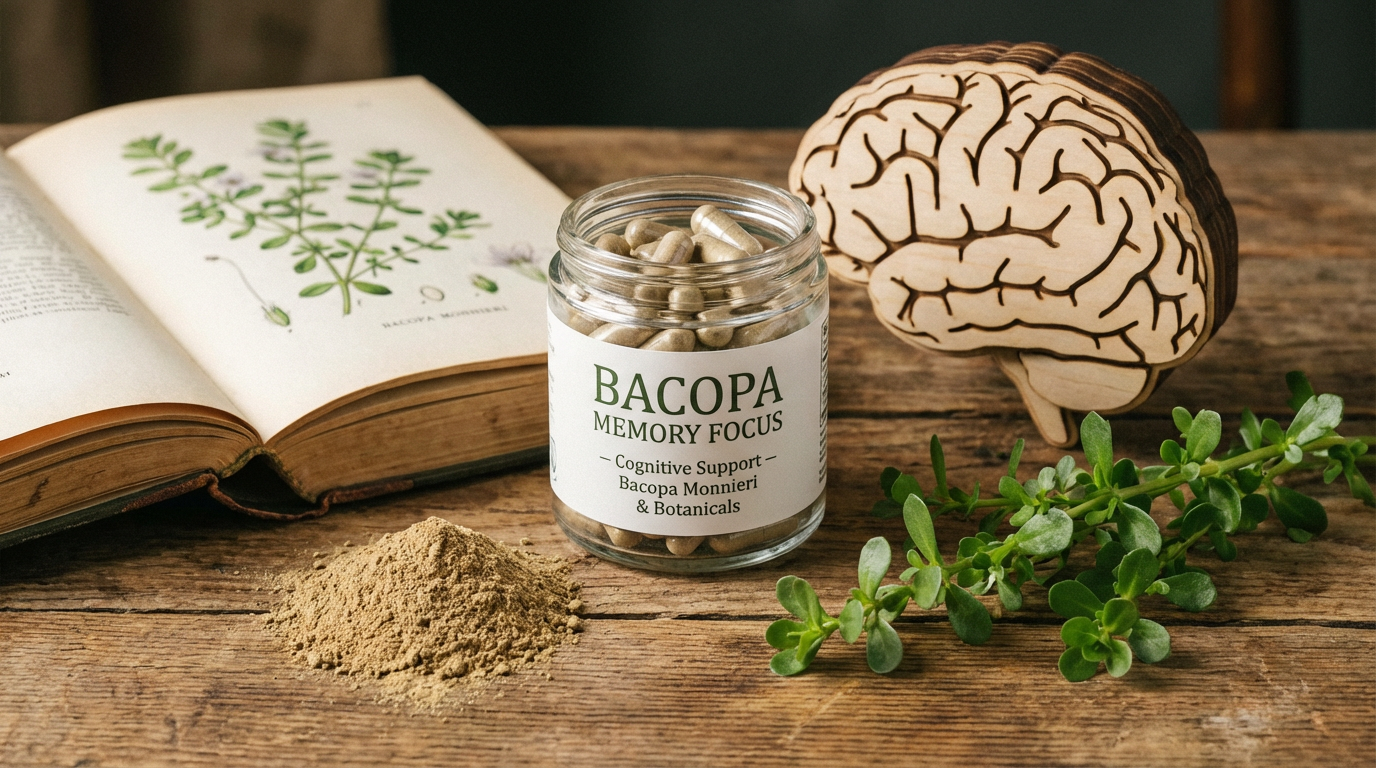
As a nutritionist I am often asked about herbs that may support memory, learning and focus. Bacopa monnieri (Brahmi) is one of the most studied Ayurvedic herbs for cognitive support. It is used traditionally to support memory, learning and calm focus rather than stimulation. This guide covers what the evidence suggests, how to dose and time it, who might benefit, and who should be cautious. For product options you can browse focus and memory formulas, Ayurvedic herbs, and herbs on iHerb.
What Is Bacopa Monnieri?
Bacopa monnieri is a creeping herb used in Ayurveda for centuries. The active compounds of interest include bacosides, which are thought to support nerve cell communication and protect against oxidative stress in the brain. Unlike stimulants, bacopa is typically described as supporting sustained focus and memory over time rather than giving an immediate boost. Effects are usually cumulative and may take several weeks of consistent use to notice.
What the Evidence Shows
Human trials have looked at bacopa for memory, learning speed, and attention. Results are mixed but several studies, including those using standardized extracts (e.g. CDRI 08, Bacognize), suggest potential benefits for memory recall and learning acquisition when taken over 8–12 weeks. Not every study finds significant effects; differences may be due to extract type, dose, duration, and population. Overall, bacopa is one of the better-studied botanicals for cognitive support, with a reasonable safety profile when used at standard doses. It is not a replacement for sleep, good nutrition, or treatment for medical conditions affecting cognition.
Dosing and Timing
Most studies use standardized extracts at doses equivalent to 300–600 mg of bacopa dry herb or 100–300 mg of extract (check the label for bacoside content; 40–55% bacosides is common). Taking bacopa with food may improve absorption and reduce the chance of stomach upset. Consistency matters: use daily for at least 8–12 weeks before judging effect. Splitting the dose (e.g. morning and evening) is an option if a single dose causes mild GI discomfort. Do not exceed the dose recommended on the product; more is not necessarily better and high doses have not been shown to improve outcomes.
Who Might Benefit
Adults looking for gentle cognitive support—memory, learning, or sustained focus—may consider bacopa as part of a broader approach that includes sleep, nutrition, and mental load management. Students and people in learning-intensive roles sometimes use it during study periods. It is not a treatment for dementia, ADHD, or other diagnosed conditions; those require medical guidance. If you are healthy and want to try bacopa for general cognitive support, a standardized extract at a standard dose for 2–3 months is a reasonable trial.
Safety and Who Should Be Cautious
Bacopa is generally well tolerated at standard doses. Possible side effects include mild digestive upset; taking with food often helps. Bacopa may slow gut motility in some people, so those with existing digestive issues should start with a low dose. There is limited data on use during pregnancy and breastfeeding; avoid unless advised by a healthcare provider. Bacopa can interact with medications that affect the thyroid, acetylcholine, or sedatives; if you take prescription drugs, check with your doctor before starting. Do not use bacopa to replace prescribed treatments for cognitive or mood disorders.
Bacopa vs Other Cognitive Supplements
Bacopa is often compared to other botanicals or nootropics. Unlike caffeine or stimulant-based pre-workouts, bacopa does not produce a quick alertness boost; it is used for longer-term support. Compared to ginkgo, bacopa has more human data focused on memory and learning. Compared to rhodiola or ashwagandha, bacopa is less associated with energy or stress modulation and more with memory and focus. Stacking multiple cognitive supplements is not always better; starting with one (e.g. bacopa) and assessing after 8–12 weeks is a sensible approach.
Forms and Quality
Look for products that specify a standardized extract (e.g. Bacopa monnieri extract with a stated bacoside percentage). This helps ensure consistency. Capsules and tablets are common; follow the label for dose per serving. Store in a cool, dry place and use by the date on the package.
Practical Tips
- Use a standardized bacopa extract at the dose on the label (typically 300–450 mg extract or equivalent).
- Take with food to support absorption and reduce GI upset.
- Give it time: 8–12 weeks of daily use before judging effect on memory or focus.
- Do not stack many new cognitive supplements at once; start with bacopa and assess.
- If you take medications or have thyroid or digestive conditions, check with your doctor before use.
FAQ
When will I notice an effect?
Most studies show effects after 8–12 weeks of consistent use. Bacopa is not an immediate focus booster; it is used for gradual support of memory and learning.
Can I take bacopa with caffeine?
Many people do. Bacopa is not strongly stimulating; combining with moderate caffeine is usually fine. If you are sensitive, take bacopa with a meal and keep caffeine moderate.
Is bacopa safe long-term?
Studies have used bacopa for several months with a good safety profile. There is limited long-term data beyond a year; cycling (e.g. 3–4 months on, 1 month off) is an option if you use it for extended periods.
Nutrition and Brain Health Around Bacopa
No herb replaces a balanced diet. Omega-3s, B vitamins, and adequate protein support brain function; poor sleep and chronic stress undermine focus and memory. If you take bacopa, pair it with good sleep habits, regular physical activity, and a diet that meets your needs. Hydration and avoiding extreme calorie restriction also matter for mental clarity.
When Not to Rely on Bacopa Alone
Do not use bacopa as the only response to significant memory loss, confusion, or mood changes; those need medical evaluation. If you have ADHD, dementia, or another diagnosed condition, follow your doctor's treatment plan and only add bacopa with their approval. Bacopa is a complementary option for generally healthy adults seeking mild cognitive support, not a substitute for diagnosis or treatment.
Common Mistakes When Taking Bacopa
Expecting quick results within a week or two is a common mistake; bacopa works gradually over 8–12 weeks. Taking it on an empty stomach when you are prone to digestive upset can cause mild GI issues; take with food. Stacking bacopa with many other new nootropics or cognitive supplements at once makes it hard to know what is helping or causing side effects; start with bacopa alone and assess. Ignoring sleep and stress while relying on bacopa for focus rarely works; the herb supports memory and learning but does not replace rest or stress management. Using a non-standardized product or unclear dose makes it difficult to compare with the research; choose a labeled extract with a stated bacoside content.
Bacopa and Study or Work Routines
If you use bacopa for learning or focus, pair it with good study or work habits: consistent sleep and wake times, blocks of focused work with breaks, and a diet that supports brain health (adequate protein, omega-3s, B vitamins). Bacopa may support retention and calm focus over time; it does not replace the need for repetition, good note-taking, or rest. Students and knowledge workers often see the best results when they take bacopa daily for at least 2–3 months while maintaining a stable routine. Avoid the temptation to add more cognitive supplements quickly; give bacopa a fair trial first.
When to Re-evaluate
After 8–12 weeks of consistent use, assess whether you notice any improvement in memory, learning speed, or sustained focus. If you do, you can continue at the same dose or consider a short break (e.g. 1 month off) to see if the effect persists. If you notice no benefit and have no side effects, you may try a different standardized extract or dose once, or stop and focus on sleep, nutrition, and stress. If you experience digestive issues, fatigue, or other discomfort, try taking bacopa with a larger meal or splitting the dose; if problems continue, discontinue and discuss with your doctor. Do not assume that more bacopa or stacking with other nootropics will help; often less is more.
Bacopa in Context: Sleep and Stress First
Cognitive performance depends heavily on sleep quality, stress levels, and nutrition. No herb can fully compensate for chronic sleep restriction, high stress, or a diet that is deficient in key nutrients. If you are considering bacopa for memory or focus, first ensure that you have addressed the basics: 7–8 hours of sleep where possible, some form of stress relief or recovery, and a diet that includes enough protein, healthy fats, and micronutrients. Bacopa can then act as a supportive layer rather than a substitute for a broken foundation. Many people find that improving sleep and reducing overwhelm gives a larger boost to clarity than adding another supplement; use bacopa as one tool among several.
Combining Bacopa With Other Habits
Bacopa pairs well with habits that support brain health: regular physical activity (even 20–30 minutes of walking can help mood and focus), adequate hydration, and structured work or study blocks with real breaks. Some people combine bacopa with omega-3s or a B-complex for general cognitive support; there is no strong evidence that stacking many nootropics is better than using one or two consistently. If you take bacopa with other supplements, keep the total number low so you can tell what is helping. Avoid starting bacopa, rhodiola, ginkgo, and several others in the same week; add one, evaluate for 2–3 months, then consider another if needed.
Final Checklist Before You Start
Choose a standardized bacopa extract (e.g. 40–55% bacosides) and check the dose per serving. Plan to take it with food daily for at least 8–12 weeks before judging effect. If you take prescription medications (especially for thyroid, mood, or sleep), or have digestive or thyroid conditions, check with your doctor before starting. Set a simple reminder (e.g. with breakfast or dinner) so you do not miss doses. Track memory, focus, or learning in a simple way (e.g. how you feel after study sessions or at the end of the day) so you have a baseline to compare after 2–3 months. Do not expect overnight results; bacopa is a gradual support, not a quick fix. Store the product in a cool, dry place and use by the expiry date; if you notice any digestive discomfort, try taking it with a larger meal or splitting the dose into two smaller amounts (e.g. morning and evening). If side effects persist, discontinue and speak with your doctor.
Why 8–12 Weeks Matters
Most clinical trials that show benefits for memory or learning use bacopa for at least 8 weeks, and many use 12 weeks. The herb is thought to support nerve cell communication and adaptation over time rather than producing an immediate stimulant-like effect. If you stop after two or three weeks because you do not feel different, you have not given it a fair trial. Commit to a daily dose with food for 2–3 months, then compare your baseline (e.g. how easily you recall information, how sustained your focus is) with your experience in the last few weeks. If there is no improvement and no side effects, you can try a different extract or stop; if there is improvement, you can continue at the same dose or discuss cycling with your doctor. Do not add several other nootropics or cognitive supplements during the same trial period; that makes it impossible to know whether bacopa or something else is helping or causing side effects. A single, consistent intervention for 8–12 weeks gives you a clear picture. Store bacopa in a cool, dry place and use by the expiry date; if you notice mild digestive upset, take it with a larger meal or split the dose. If you have thyroid issues or take thyroid medication, or if you take sedatives or drugs that affect acetylcholine, get your doctor's okay before starting bacopa.
Summary
Bacopa monnieri is a well-studied Ayurvedic herb that may support memory, learning and calm focus when used consistently at standard doses. Choose a standardized extract, take with food, and allow 8–12 weeks to evaluate. It is not a replacement for sleep, nutrition, or medical care. Use it as part of a healthy lifestyle and, if you have health conditions or take medications, check with your doctor first.