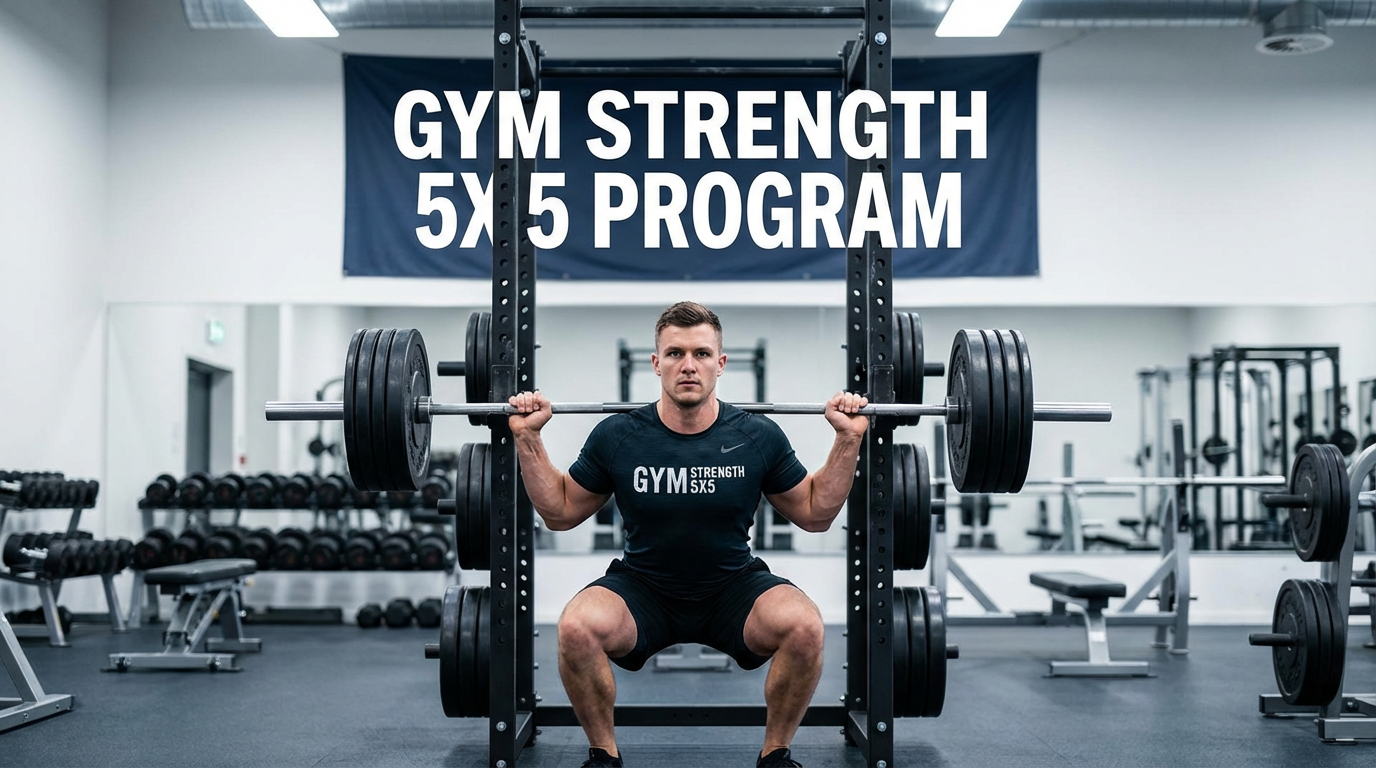
The 5x5 strength program is one of the most popular entry-level programmes for building base strength. You perform five sets of five reps on a small number of compound lifts, add weight gradually over time, and train three days per week. It is simple, effective, and easy to track. As a fitness coach, I recommend it for beginners and early intermediates who want to get stronger on the big lifts without complex periodisation. This guide covers how the programme works, which lifts to use, how to progress and when to deload, and how to support recovery with nutrition and rest.
What Is a 5x5 Program?
A 5x5 programme means five sets of five repetitions per exercise. You typically use three main lifts per session and alternate between two sessions (often called A and B) across the week. For example: Workout A — squat, bench press, barbell row; Workout B — squat, overhead press, deadlift. You train three times per week (e.g. Monday, Wednesday, Friday), so each workout repeats every 4–5 days. The goal is to add a small amount of weight each session (linear progression) until you can no longer complete 5x5 with good form, at which point you deload and build back up. The simplicity is the strength of the programme: few exercises, clear sets and reps, and a straightforward progression rule.
Why 5x5 Works
Five sets of five reps sit in a range that builds both strength and muscle. The volume is enough to drive adaptation without being so high that recovery becomes an issue for novices. Compound lifts recruit multiple muscle groups and teach movement patterns that transfer to daily life and sport. Linear progression—adding 2.5 kg to the bar (or 1.25 kg per side) each session—works well when you are new to lifting because your nervous system and muscles adapt quickly. As you get more advanced, progress slows and you may need to switch to a programme with periodisation or different set/rep schemes; but for the first several months to a year, 5x5 is an excellent choice.
The Main Lifts
Squat: The backbone of the programme. Use the back squat (high bar or low bar) or a safe variation. Squat in both Workout A and B so you practise the movement frequently. Form matters: depth (hip crease at or below knee), neutral spine, and controlled descent and ascent.
Bench press: Horizontal push for chest, shoulders, and triceps. Keep your feet flat, retract your shoulder blades, and lower the bar to your chest with control. Use a spotter when going heavy.
Barbell row: Horizontal pull for the back. Bent-over row or pendlay row are common. Keep your torso stable and pull the bar to your lower chest or upper abdomen. Avoid using momentum.
Overhead press: Vertical push for shoulders and triceps. Press the bar from the front-rack position to lockout. Brace your core and avoid excessive layback.
Deadlift: Usually one heavy set of five (1x5) rather than 5x5 because of the demand on the nervous system and lower back. Perform after squats and overhead press on B day. Focus on hip hinge, neutral spine, and locking out at the top.
Programming and Progression
Start with a weight you can lift for 5x5 with good form—often the empty bar or a light load for squats and presses, and a moderate weight for deadlifts. Add 2.5 kg (1.25 kg per side) to squats and deadlifts each time you complete 5x5 (or 1x5 for deadlift). For bench, row, and overhead press, add 2.5 kg when you complete all sets. If you fail to complete 5x5—for example you get only 4 reps on the fifth set—repeat the same weight next time. If you fail three sessions in a row on the same exercise, reduce the weight by about 10% (deload) and build back up. This prevents stalling and injury from grinding through the same weight repeatedly.
Who It Is For
The 5x5 programme suits beginners and early intermediates. If you have never lifted or have less than a few months of consistent training, it is an ideal starting point. If you have been training for a year or more and have already run linear progression, you may find that adding weight every session is no longer possible; in that case, consider a programme with weekly or monthly periodisation. The programme is demanding on the lower body (squatting three times per week) and the lower back (squat and deadlift); if you have existing back or knee issues, get clearance from a healthcare provider and consider modifications (e.g. box squats, trap bar deadlift).
Recovery and Nutrition
With three full-body sessions per week, recovery is critical. Sleep 7–8 hours per night; insufficient sleep impairs strength gains and increases injury risk. Eat enough calories and protein to support muscle repair—many lifters aim for 1.6–2.2 g protein per kg body weight when training for strength and muscle. Carbohydrates around training can help performance. Protein supplements and creatine can help meet targets when whole foods fall short; they do not replace a balanced diet. Stay hydrated and avoid adding large amounts of other intense activity (e.g. long runs, extra gym sessions) until you are accustomed to the programme.
Form and Safety
Quality of movement matters more than the number on the bar. Learn the lifts from a coach, video resource, or experienced lifter if possible. Warm up with light sets before your working sets. Do not sacrifice form for an extra rep or extra weight—if your back rounds on the deadlift or your knees cave on the squat, reduce the load and fix the pattern. Use a spotter for bench press when going heavy. If you feel sharp pain (as opposed to muscle fatigue), stop and seek advice. A single deload week every 4–6 weeks can help prevent burnout and allow joints and connective tissue to adapt.
Common Mistakes
Starting too heavy leads to early stalling and poor form. Adding weight too fast (e.g. 5 kg per session) is unsustainable. Skipping warm-ups increases injury risk. Ignoring failed sessions and trying the same weight repeatedly without deloading leads to frustration and sometimes injury. Doing too much extra work (isolation, cardio) on top of 5x5 can compromise recovery. Stick to the programme for at least 8–12 weeks before judging results; consistency beats short-term intensity.
When to Move On
When linear progression no longer works—you cannot add weight each session even after deloads—consider an intermediate programme. Examples include 5/3/1, Texas Method, or other periodised plans that vary volume and intensity by week or month. The 5x5 programme gives you a strong foundation; the next step is to periodise your training while continuing to prioritise the main lifts.
Evidence and Practical Tips
Research on resistance training shows that compound movements, progressive overload, and sufficient volume drive strength and hypertrophy. The 5x5 structure fits these principles. Quality matters: prioritise sleep, protein, and recovery. Many lifters use protein powder and creatine to support training; use them as part of a balanced diet. If you have health conditions or take medications, consult a healthcare provider before starting. Track your lifts and how you feel; deload when progress stalls. This guide is for education and does not replace advice from a coach or doctor.
Takeaways
- 5x5 means five sets of five reps on compound lifts; train three days per week with two alternating workouts.
- Progress: add 2.5 kg per session when you complete all sets; deload after three failed sessions.
- Form and safety: learn the lifts, warm up, and do not sacrifice technique for weight.
- Recovery: sleep, protein, and adequate calories; protein and creatine can support when diet allows.
- When linear progression stalls, consider an intermediate periodised programme.
The 5x5 programme is a proven way to build base strength; follow it consistently and support it with recovery and nutrition.