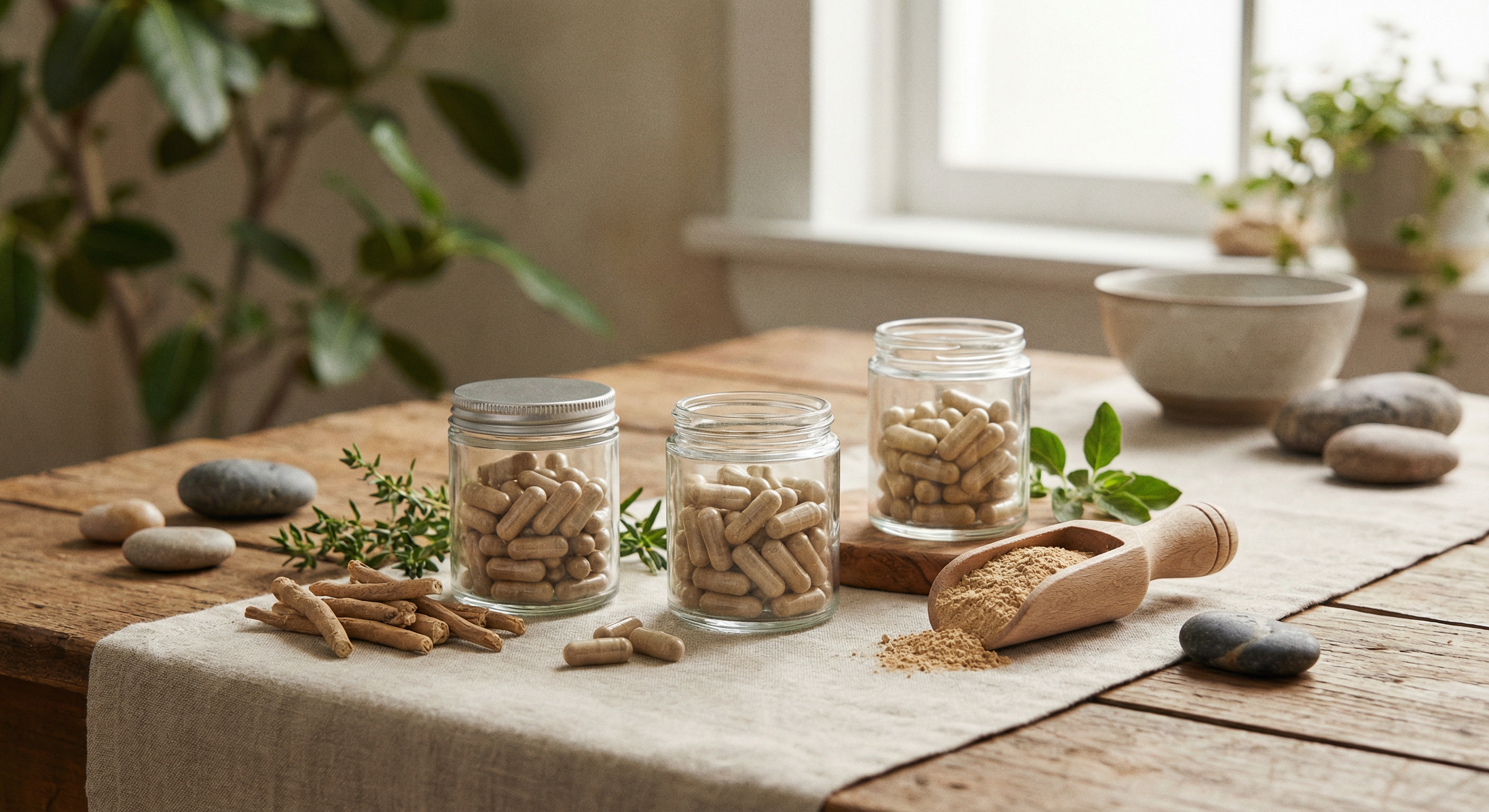
Ashwagandha is one of the most popular adaptogens, but buying it is confusing because the label rarely tells the full story. Two products can both say “ashwagandha”, yet behave differently in real life. One may feel calming and sleep-friendly, another may feel more energizing, and a third may cause stomach upset. The difference is often not the plant itself, but the form: which part of the plant was used, how it was extracted, and how it was standardized.
This guide explains the main ashwagandha forms you will see (including KSM-66, Sensoril, root extracts, and other common variations), what “withanolides” really means, and how to choose a product based on your goal. It is educational content, not medical advice. If you are pregnant, have thyroid disease, use sedatives, have autoimmune conditions, or have had liver issues related to supplements, consult a clinician before using ashwagandha.
Quick takeaways
- Not all ashwagandha is the same: extract type and plant part matter.
- Standardization matters: “withanolides %” tells you something, but not everything.
- KSM-66 and Sensoril are branded extracts with different characteristics and typical use cases.
- Pick a goal first: sleep and stress support often calls for a different approach than training support.
- Start low and track: run a 6–8 week trial with simple metrics.
What is ashwagandha and why forms vary
Ashwagandha (Withania somnifera) is traditionally used for stress resilience, sleep support, and general vitality. In supplements, it is most commonly sold as a root powder or a root extract. Some products also include leaf material or use different extraction methods.
Why does this matter? Because extracts concentrate different compounds at different ratios. Two extracts can have the same withanolide percentage but still differ in the specific withanolides present, the presence of other plant constituents, and how the product feels. That is why your experience can vary even if the label looks similar.
Withanolides: what the label tells you (and what it does not)
Withanolides are the group of compounds most commonly used to describe ashwagandha potency. Many products list “withanolides” as a percentage. This is helpful, but you should keep expectations realistic:
- Helpful: standardization can improve consistency across batches, which makes trials easier.
- Not perfect: different labs and methods can measure withanolides differently.
- Not complete: the overall extract profile can differ even at the same percentage.
A practical rule: treat withanolide standardization as a minimum quality signal, not a guarantee of a specific effect.
Main forms you will see
1) Whole root powder
Root powder is the simplest form. It is closer to traditional use, but potency can vary. Doses are often larger by weight, and the taste can be strong and earthy. Root powder may be a fit if you want a food-like approach and tolerate larger servings, but it can be harder to run a precise trial.
2) Standardized root extracts (generic)
Many products are standardized root extracts without a branded name. They can be excellent if the company is reputable and labeling is clear. The upside is predictable dosing. The downside is that “root extract” still covers many possibilities: solvent type, extraction ratio, and withanolide measurement methods can differ.
3) Branded extracts (commonly KSM-66 and Sensoril)
Branded extracts are proprietary preparations often used in studies. The advantage is that you can more easily match a product to research and expect the extract to be consistent over time. The tradeoff is price and, sometimes, a stronger effect profile that may not fit everyone.
KSM-66: what it is and who it fits
KSM-66 is a well-known branded ashwagandha extract marketed as a root-only preparation. It is often discussed in the context of stress support, training adaptation, and general resilience. People who choose it usually want a standardized extract that has been used in multiple studies.
Common reasons people choose KSM-66:
- they want a root-only extract
- they want a consistent supplement they can track for several weeks
- they want stress support that does not feel overly sedating
Possible downsides: some people still feel daytime sleepiness, digestive upset, or a mood shift. If you are sensitive, start lower and assess next-day function.
Sensoril: what it is and who it fits
Sensoril is another well-known branded extract. It is often associated with stress and relaxation support. Some users report it feels more calming, especially when taken later in the day. Individual response varies, but many people think of Sensoril as a more wind-down oriented option.
Common reasons people choose Sensoril:
- high stress and difficulty winding down
- sleep quality is a main goal
- they prefer a product that feels distinctly calming
Possible downsides: if it feels too calming, it can reduce training drive or cause morning grogginess. That is not a sign the product is bad, just that the form may not match your goal or dose.
Root-only vs root-and-leaf: does it matter?
Some products are root-only, others include leaf. Leaf-containing extracts can have a different compound profile and can feel different. This is not automatically good or bad, but it is a reason to treat each product as its own trial. If you want to mirror most traditional and many modern supplement approaches, root-only is the default. If you are exploring broader extracts, do it with extra caution and careful tracking.
How to choose the right form for your goal
Goal: stress resilience and calmer mood
For many people, stress resilience is the main goal. A standardized extract taken consistently can help you evaluate whether your day-to-day baseline improves. Consider evening dosing if you notice a calming effect.
Goal: sleep quality and winding down
If the barrier is racing thoughts and a hard time shutting off, a more calming-oriented extract taken in the evening can make sense. Pair it with sleep basics: dim lights, stable wake time, and reduced late caffeine.
Goal: training support and stamina
For training, the biggest factors are still fueling, programming, and sleep. Ashwagandha is not a pre-workout. If you want to try it for training adaptation, choose a standardized product, keep your plan stable, and track performance markers for 6–8 weeks.
Typical dosing and timing strategies
Study doses and product doses vary. Instead of chasing an exact number, focus on a safe, repeatable process:
- Start low: assess tolerance for a few days.
- Take consistently: daily use is easier to evaluate than occasional use.
- Adjust timing: if it makes you sleepy, take it later; if it feels activating, take it earlier.
For many people, evening dosing fits sleep and stress goals, while split dosing may fit baseline resilience goals. Your response matters more than theory.
How long to trial and how to track results
Ashwagandha effects, if they occur, usually build over time. A practical trial is 6–8 weeks. Track outcomes you can actually measure:
- Sleep: time-to-sleep, awakenings, morning alertness.
- Stress: perceived stress (1–10) and irritability.
- Training: consistency, key lift numbers, perceived effort.
- Side effects: stomach upset, headaches, grogginess, mood changes.
If there is no clear benefit after a consistent trial, stop. Supplements should earn their place.
Safety and interactions (do not skip)
Ashwagandha is commonly tolerated, but it is still biologically active. Be cautious if you:
- are pregnant or breastfeeding: avoid unless a clinician specifically approves.
- have thyroid disease: discuss with your clinician before experimenting.
- use sedatives or sleep medications: combined drowsiness can be risky.
- have autoimmune conditions or use immunosuppressants: confirm safety first.
- have liver concerns: avoid self-experimenting if you have a history of supplement-related liver issues.
Stop use if you feel significantly worse. Seek medical help for severe symptoms or signs of liver distress.
Quality checklist: how to avoid weak products
- Clear labeling: root vs root-and-leaf, standardized extract details.
- Realistic claims: avoid instant results promises.
- Consistency: prefer products that can be repeated month to month.
- Simple formula: avoid complex multi-herb blends when you are trying to evaluate ashwagandha.
FAQ
Is higher withanolides percentage always better?
Not necessarily. Higher is not automatically better for your goal, and different extracts can feel different even at similar percentages. Use outcomes and tolerability to decide.
Should I cycle ashwagandha?
A reasonable approach is a 6–8 week trial, then a short break to see whether benefits persist and whether you still need it.
Can I take it with creatine?
Often yes, because they work through different mechanisms. Introduce changes one at a time if you want clean conclusions.
Key takeaways
- Ashwagandha form matters: extract type, plant part, and standardization drive differences.
- KSM-66 and Sensoril are popular branded extracts with different typical use cases.
- Pick a goal, run a consistent 6–8 week trial, and track outcomes.
- Prioritize safety, especially with thyroid issues, sedatives, pregnancy, autoimmune conditions, and liver history.