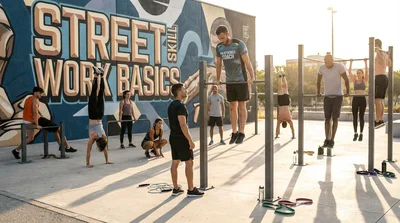
Calisthenics—training with your own bodyweight—can build real muscle when you apply the same principles that drive hypertrophy in the gym: progressive overload, sufficient volume, and recovery. As a sport doctor, I see many people assume that bodyweight work is only for endurance or skill; in fact, with the right progressions and programming, you can gain size and strength without equipment or with minimal kit. This guide covers the basics of calisthenics hypertrophy: how to progress, how much volume to do, how to balance push and pull, and how nutrition and recovery support growth. For support around training, you can browse protein and creatine on iHerb.
Why bodyweight training can build muscle
Hypertrophy happens when muscle is challenged with enough tension and volume and then given recovery and nutrition. You can create that tension with barbells, dumbbells, or your bodyweight. The key is to work in a rep range and difficulty where sets are challenging (e.g. close to failure or with enough load). Bodyweight exercises like push-ups, pull-ups, dips, rows (using a bar or rings), and leg progressions (pistol squats, Nordic curls, single-leg work) can all be scaled so that you are in an effective range for growth. The limitation is often the upper body: once basic push-ups or pull-ups become easy, you need progressions (e.g. archer push-ups, weighted vests, one-arm work, or rings) to keep overloading.
Progressive overload in calisthenics
You can progress by: (1) adding reps per set, (2) adding sets, (3) using harder progressions (e.g. from knee push-ups to full push-ups to deficit or archer push-ups), (4) adding external load (weighted vest, dip belt), (5) slowing the tempo, or (6) reducing rest. Most people combine several of these. Track your workouts so you know when to advance. For example, once you can do 3 sets of 12 full push-ups with good form, move to a harder variation or add weight so that you are again working in a range where 8–15 reps are challenging. Same for pull-ups: progress from bands or negatives to full pull-ups, then to weighted or one-arm progressions.
Volume and frequency
Research on resistance training suggests that roughly 10–20 sets per muscle group per week can support hypertrophy, with diminishing returns beyond that for most people. In calisthenics, a “set” counts when the exercise is hard enough to be in an effective rep range (e.g. 6–20 reps to near failure). So you might do push-ups and dips for chest/triceps, pull-ups and rows for back/biceps, and leg progressions for lower body, spreading volume across the week. Training each muscle group 2–3 times per week is a solid default. Allow at least one rest day between heavy sessions for the same muscles if you are pushing intensity.
Push, pull, and legs
Balance your programme so you do not overdevelop one plane. Push: push-ups (and progressions), dips, pike push-ups or handstand push-ups for shoulders. Pull: pull-ups, chin-ups, rows (inverted or with rings), face pulls if you have a band. Legs: squats (bodyweight, pistol, or weighted), lunges, Nordic hamstring curls, single-leg deadlifts, calf raises. If you have no equipment, you can still progress push-ups and squats with tempo and single-leg options; for pull, you need at least a bar or rings or a sturdy table for rows.
Rep ranges and intensity
For hypertrophy, aim for sets where you approach muscular failure in roughly the 6–20 rep range. If an exercise is too easy (e.g. you can do 30 push-ups), make it harder so that 8–15 reps are demanding. If you cannot do enough reps of a progression (e.g. only 3 pull-ups), use bands, negatives, or an easier variation until you build up. Quality of movement matters: full range of motion, controlled tempo, and no cheating so that the target muscles do the work.
Recovery and nutrition
Muscle grows during recovery, not during the workout. Sleep, adequate protein (e.g. 1.6–2.2 g per kg body weight per day for those focused on muscle gain), and enough total calories support hypertrophy. If you train hard and eat in a large deficit, you will find it hard to add muscle. A small surplus or maintenance intake with enough protein is usually better for growth. Hydration and sensible supplementation (e.g. creatine, which is well supported for strength and hypertrophy) can help. Compare protein and creatine on iHerb if you use supplements.
Common mistakes
Avoid doing only one rep range or one exercise per muscle group; vary angles and progressions. Do not skip legs; lower-body calisthenics can be very demanding with single-leg and Nordic progressions. Do not progress too fast and sacrifice form; better to add reps or sets first, then move to a harder variation. Finally, do not assume that “more volume always works”—recovery matters. If you are sore or performance is dropping, add a rest day or reduce volume.
When to add equipment
A pull-up bar or gymnastics rings greatly expands what you can do for back and biceps. A dip station or parallel bars help for chest and triceps. A weight vest or dip belt allows progressive overload without changing the exercise. Resistance bands can assist pull-ups or add load to push-ups. You can get far with minimal kit; add equipment as you need harder progressions.
FAQ
Can I build as much muscle with calisthenics as with weights?
You can build substantial muscle with bodyweight if you progress consistently. For very advanced lifters, heavy barbell work may eventually allow more absolute load, but most people can get strong and muscular with calisthenics alone or combined with some weights.
How many times per week should I train?
2–4 sessions per week is common. Hit each muscle group at least twice, with adequate recovery between sessions.
Do I need to eat more to gain muscle with calisthenics?
Yes. Hypertrophy requires enough protein and enough total energy. A small surplus or maintenance with high protein is typical for muscle gain.
Key takeaways
- Calisthenics can build muscle when you use progressions and volume that challenge you in an effective rep range (e.g. 6–20 reps to near failure).
- Progress via harder variations, added load, more reps or sets, or tempo; track workouts to keep overloading.
- Balance push, pull, and legs; train each muscle group 2–3 times per week with 10–20 sets per week.
- Recovery and nutrition (sleep, protein, adequate calories) are essential for growth.
- Add equipment (bar, rings, vest) as you need harder progressions; form and consistency matter more than gear.