What the Planche Is
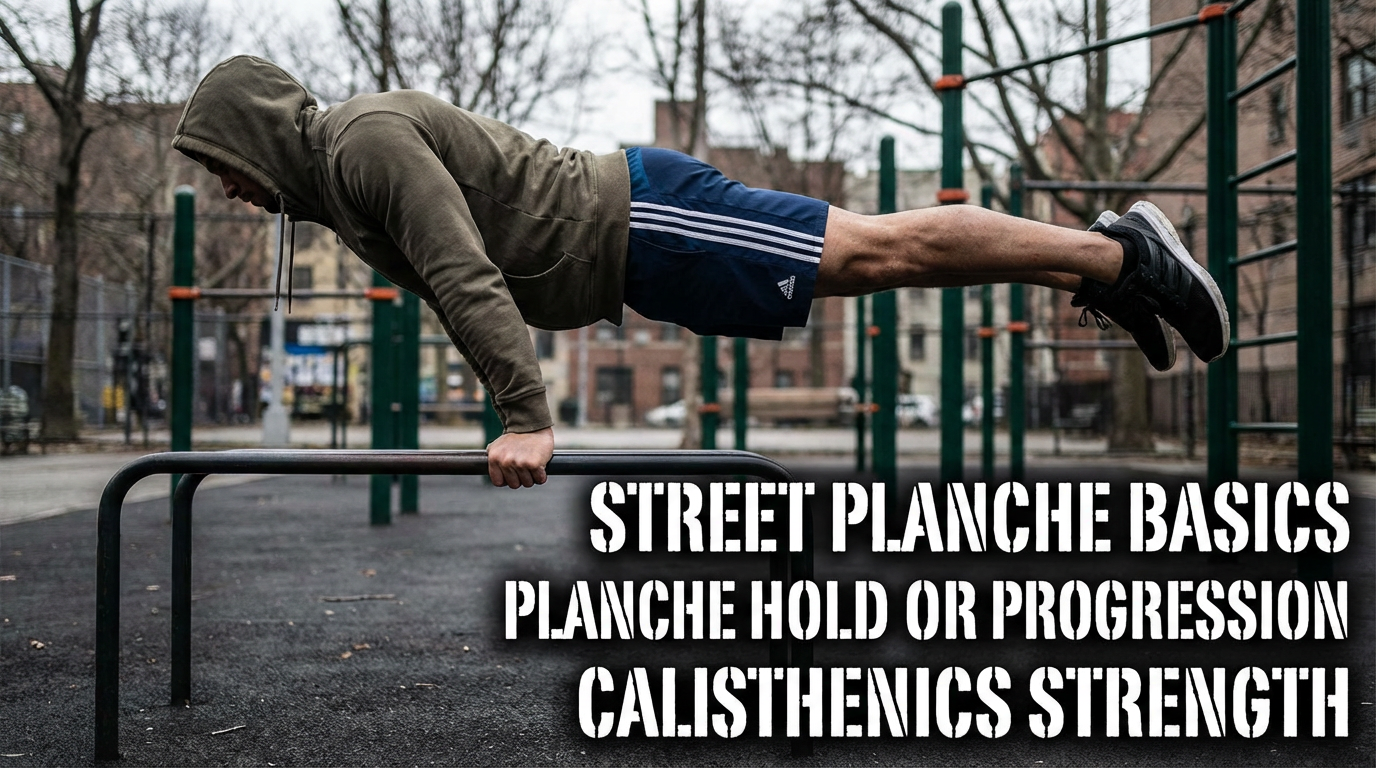
The planche is a horizontal hold: you support your body on your hands with your legs (and often arms) straight, parallel to the ground. No feet on the floor—all weight on the hands. It demands serious straight-arm pushing strength, anterior delt and pec engagement, and core tension. You can train it on parallettes, floor, or bars. This guide covers the basics: what you need before you start, the main progressions (tuck → advanced tuck → straddle → full), and how to program it so you build strength without burning out your joints.
Prerequisites
You need a solid foundation: planche lean (lean forward on hands with feet on the ground), support hold (30+ sec on parallettes or bars), and strong pushing—push-ups, dips, and ideally some planche lean or frog stand. Wrists and shoulders must be healthy; planche puts a lot of stress on both. If you have pain, address it first. Don''t rush to tuck planche until you can hold a solid planche lean (feet on floor, body horizontal or close) for 20–30 seconds and feel comfortable in support.
The Lean and Weight Shift
Planche is all about shifting your weight forward so your center of mass is over your hands. That means leaning forward (planche lean): hands on floor or parallettes, feet on the ground, and you push your shoulders forward past your hands. The more you lean, the more weight moves onto your arms. Train the lean: from standing or from push-up position, walk your feet toward your hands while pushing your shoulders forward, or do lean holds with feet on the ground. Build up to 3×30 seconds at a strong lean before you try to lift your feet. This teaches the body position and builds the necessary strength.
Progression 1: Tuck Planche
Tuck planche: support on hands, knees tucked to chest, feet off the ground. Start from a lean or from frog stand (knees on arms). Squeeze the tuck tight and hold. 3×10–20 seconds. Focus on protraction (spreading the shoulder blades), locked elbows, and keeping the hips high. If your hips sink or you can''t get your feet off, work more planche lean and frog stand. Once you have 3×15–20 sec tuck, move on.
Progression 2: Advanced Tuck
Advanced tuck: same as tuck but your knees are slightly in front of your hips (or thighs more horizontal). This extends the lever a bit and is harder. 3×10–15 seconds. Same cues: protraction, locked arms, hips high. Build to 3×15 sec before moving to straddle.
Progression 3: Straddle Planche
Straddle planche: legs spread to the sides. Spreading the legs shortens the lever, so straddle is easier than full planche. From advanced tuck, extend one leg out to the side, then the other. Hold 3×5–15 seconds. Keep protraction and lockout; don''t let the hips drop. Straddle is a long-term goal for many—solid 10–15 second holds are strong. You can train it on floor, parallettes, or bars; bars allow a bit more clearance.
Progression 4: Full Planche
Full planche: legs together and straight, body horizontal. The longest lever and the hardest. Most people need years of consistent work to get here. From straddle, gradually bring the legs together. Start with short holds (3×3–5 sec) and build. Same principles: protraction, lockout, core tight. Don''t sacrifice form for seconds; quality holds build the skill.
Equipment and Surfaces
Floor: Hands next to hips, fingers forward or slightly out. Hard on wrists; use parallettes if wrists are an issue. Parallettes: Same body position, wrists neutral. Good for most people. Bars: Similar to parallettes; more clearance for straddle. Pick one and get consistent before switching. Rings are possible but much harder; do them after you have a solid planche on a fixed surface.
Assistance and Accessories
Planche leans (feet on floor) and lean holds build the position. Pseudo planche push-ups (lean forward, do push-ups) build strength in the lean. Band-assisted planche (band around waist, attached in front) can help you feel the full hold. Don''t rely on the band forever; use it to get a few seconds of the position, then reduce assistance. Straight-arm strength work (e.g. planche leans, support holds) is as important as bent-arm work.
Common Mistakes
Bent elbows—keep them locked. Sagging hips—squeeze core and keep hips high. No protraction—push the shoulders forward and spread the scapulae. Skipping the lean—the lean is the foundation. Training planche at the end of a long session when you''re tired—do it fresh. Too much volume—planche is demanding; 3–4 sets a few times per week is enough. If you plateau, add more lean work and ensure recovery (sleep, food, no overtraining).
Programming
Train planche 3–4 times per week when fresh. 3–4 sets of max hold (or timed, e.g. 3×15 sec) with 90–120 sec rest. Progress by adding 1–2 seconds per set per week or by moving to the next progression when you hit the target hold time. Balance with pushing and pulling so you don''t overdo anterior delt. Once you have straddle or full, maintain with 2–3 sets a couple of times per week and use the rest of your time for other skills or strength.
Summary
- Foundation: Planche lean (feet on floor), support hold, strong push. Build lean before lifting feet.
- Progressions: Tuck → advanced tuck → straddle → full. Hold times (e.g. 3×15 sec) before moving on.
- Cues: Protraction, locked elbows, hips high, core tight.
- Equipment: Parallettes or floor; bars for more clearance. Rings later.
- Volume: 3–4 sets, 3–4× per week; quality over duration. Add lean work if you plateau.
Planche is a long game. Nail the lean, then tuck, then advance step by step. Consistency and patience beat rushing.