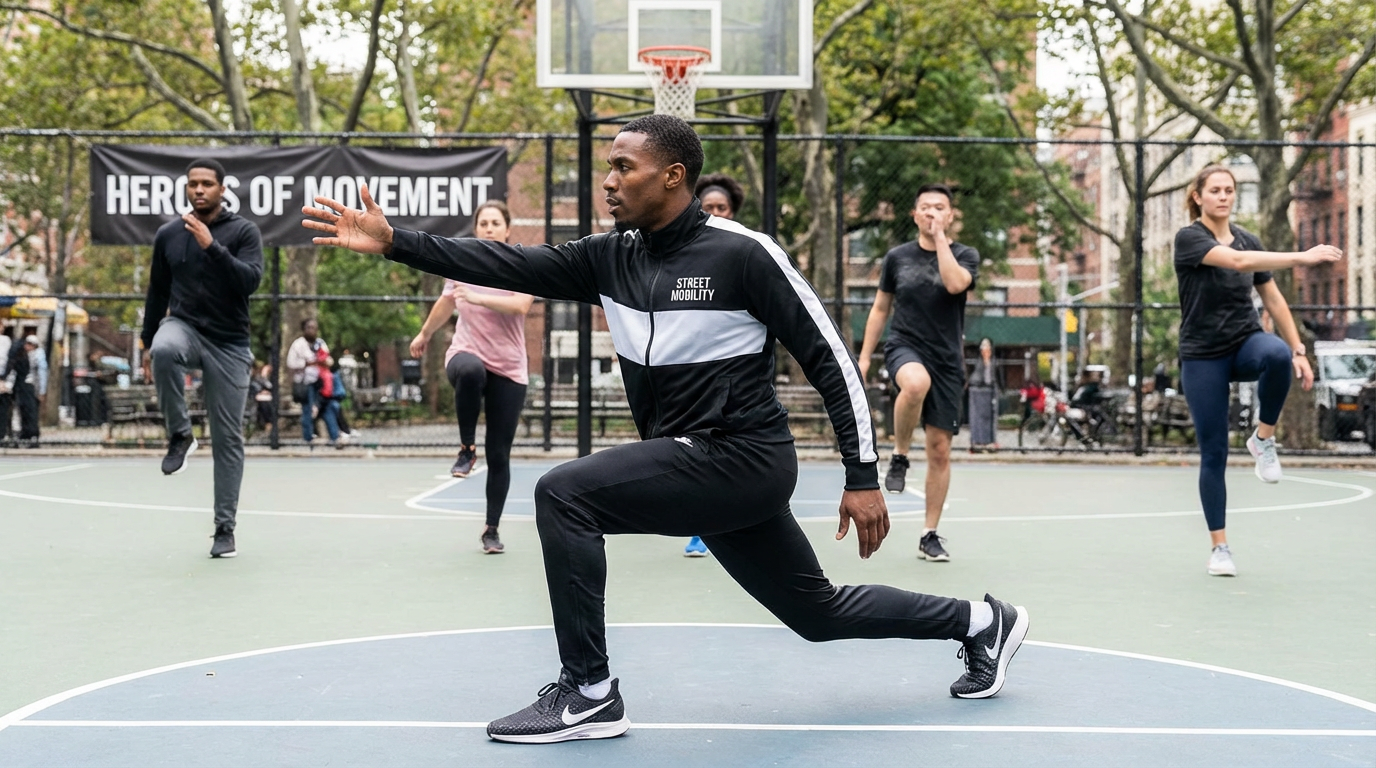
Why Warm Up Before Street Training
A good warmup raises body temperature, increases blood flow to muscles and joints, and prepares the nervous system for the work ahead. For street calisthenics — push-ups, pull-ups, handstands, and skill work — the shoulders, wrists, spine, and hips take a lot of load. A mobility-focused warmup improves range of motion, reduces the risk of strain and overuse injury, and helps you move better during the main session. Spending 8–15 minutes on a structured warmup is a worthwhile investment before every outdoor or home session.
General Principles
Start with light movement to raise heart rate and warmth (e.g. jogging, jumping jacks, or fast walking). Then move to joint circles and dynamic mobility: take each major joint through its range in a controlled way. Follow with movement-specific prep: if you are training push-ups and handstands, emphasise shoulders and wrists; if you are doing squats and lunges, emphasise hips, knees, and ankles. Finish with a few light reps of the main exercises or similar patterns. Avoid long static stretches before strength or skill work; save deep static stretching for after the session or rest days.
Wrists and Forearms
Wrists are under high load in planks, push-ups, handstands, and support holds. Warm them up with circles: make fists and rotate at the wrist in both directions, 8–10 each way. Then wrist flexor and extensor stretches: one arm extended, use the other hand to gently pull the fingers back (extensor stretch) or down (flexor stretch); hold 15–20 seconds each. Wrist rotations with the arm extended and finger waves (spread and curl) also help. If you have a history of wrist issues, add extra time here and consider parallettes or fists for push work.
Shoulders and Upper Back
Shoulders need mobility in multiple directions for healthy pushing and pulling. Arm circles: small to large, 10 each direction. Cross-body arm swings and shoulder rolls (forward and back) increase circulation. Thread-the-needle or cat-cow on all fours mobilise the thoracic spine and shoulders. Wall slides: back and arms against a wall, slide arms up and down while keeping contact; this encourages proper shoulder blade movement. Band pull-aparts or face pulls with a band (if available) activate the upper back. Spend 2–3 minutes on shoulders before heavy pushing or pulling.
Spine and Hips
Spine and hip mobility support squats, lunges, leg raises, and hollow body positions. Cat-cow: on hands and knees, round the spine (cat) then arch (cow); 8–10 reps. Hip circles: on all fours or standing, circle one hip at a time, 8 each direction. Leg swings: hold a wall or bar, swing one leg forward and back, then side to side; 10–12 each leg. World’s greatest stretch or a lunge with rotation opens the hips and thoracic spine. Deep squat hold (holding the bottom of a squat for 20–30 seconds) improves ankle and hip range. Add these before leg or core work.
Ankles and Knees
Ankle mobility affects squat depth and landing in jumps. Ankle circles: 8–10 each direction per foot. Calf stretch against a wall: one leg back, heel down, hold 20 seconds. Knee circles: slight bend, hands on knees, small circles 8 each way. If you are doing pistols or deep squats, spend extra time on ankle dorsiflexion (knee-over-toe drills with the foot on a wall or step). This reduces compensation in the knee and lower back.
Sample Warmup Flow (10–12 Minutes)
Minutes 1–2: Light cardio — jog, skip, or jump jacks. Minutes 2–4: Wrists (circles, stretches); shoulders (arm circles, rolls, wall slides). Minutes 4–6: Spine (cat-cow); hips (circles, leg swings). Minutes 6–8: Ankles (circles, calf stretch); optional deep squat hold. Minutes 8–10: Movement prep — 5–10 easy push-ups or pike push-ups; 5–10 bodyweight squats; 3–5 pull-up negatives or dead hangs if you have a bar. Minutes 10–12: A few practice reps of the first exercise of your main session. Adjust the length and focus to match your session (e.g. more wrist and shoulder work before handstand day).
What to Avoid
Do not skip the warmup when short on time — shorten it rather than omit it. Avoid long static stretching (e.g. 60-second holds) immediately before strength or skill work; it can temporarily reduce force output. Do not rush through joint circles; controlled movement is more effective than fast, bouncy motion. If something hurts during the warmup, reduce range or skip that element and consider addressing it with a professional. Consistency with a simple warmup beats an occasional perfect one.
Cool-Down and Maintenance
After the session, 5–10 minutes of light movement and optional static stretching can aid recovery. Focus on areas that felt tight (e.g. chest, shoulders, hips). For ongoing mobility, add a short daily routine (e.g. 5 minutes of hip and shoulder mobility) on rest days or as part of a morning routine. Over time, this supports better positions in your main exercises and reduces stiffness.
Summary
- Purpose: Raise temperature, increase range of motion, and prepare joints and muscles for the session.
- Order: Light cardio → joint circles and dynamic mobility → movement-specific prep → light practice reps.
- Focus areas: Wrists, shoulders, spine, hips, ankles; adjust for the day’s main exercises.
- Length: 8–15 minutes; avoid long static stretches before strength or skill work.
A street mobility warmup is a small investment that pays off in better movement, fewer niggles, and more productive sessions. Make it a non-negotiable part of every calisthenics workout.