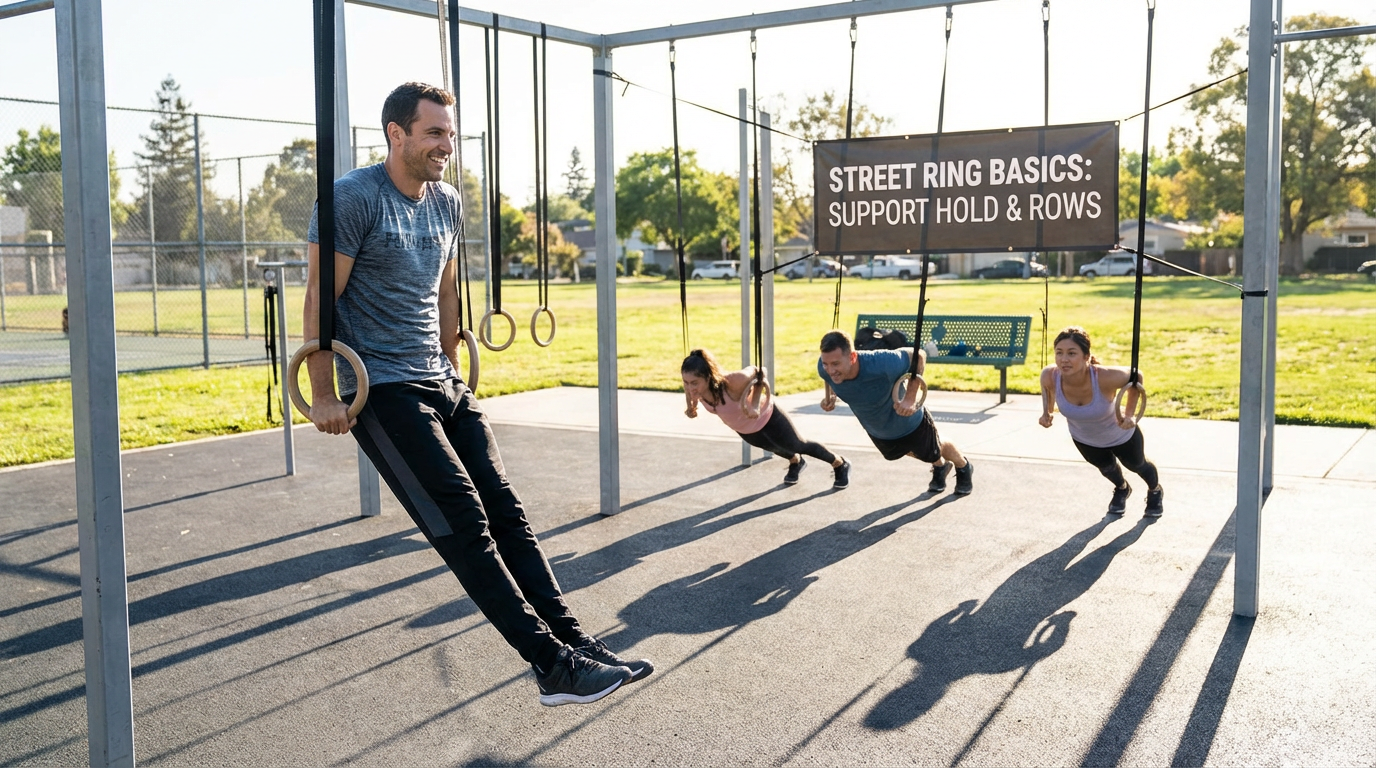
Why Train on Rings
As a CPT, I recommend rings for anyone building street or calisthenics strength: they add instability that forces shoulder stability, grip, and core control. Push and pull movements on rings transfer well to bar work and build joint-friendly strength through full range of motion. Rings are portable — hang them from a pull-up bar, tree branch, or ceiling — and scalable: adjust strap length and height to match your level. Mastering the basics (support, hang, rows, push-ups) sets the foundation for dips, pull-ups, and more advanced skills.
Setup and Safety
Mount the rings so they are stable and at a height you can reach safely. For support hold and push-ups, straps are often at arm''s length when you stand underneath; for hangs and rows, lower. Check the anchors (beam, bar, branch) for load capacity; avoid sharp edges on the straps. Use a step or box to get into support if needed; never jump down from support onto a hard surface. Warm up the shoulders and wrists before loading: arm circles, scapular movements, and light support holds prepare the joints.
Support Hold
The support hold is the first ring position to master: arms straight, body in a straight line from head to heels, rings turned out (false grip optional later). Start with feet on the ground or on a box and shift weight onto the hands; hold 10–30 seconds. Build to 30–60 seconds before adding movement. Common faults: shrugging the shoulders, letting the chest collapse, or bending the arms. Focus on pushing the rings down and apart, engaging the core and keeping the shoulders down and back. If the wrists are sensitive, use a false grip only when you have built basic strength; it increases wrist load.
Dead Hang and Active Hang
Dead hang: grip the rings, arms straight, shoulders relaxed (elevated toward the ears is acceptable in a passive hang). Build time in the hang to strengthen grip and stretch the shoulders. Active hang: pull the shoulder blades down and back, engaging the lats without bending the arms. This is the starting position for ring rows and pull-ups. Practice 3–5 sets of 20–40 second hangs 2–3 times per week. If one arm is weaker, use an asymmetric hold or add a leg assist and progress to full hang.
Ring Rows
Set the rings at waist to chest height. Hold the rings, walk the feet forward so the body is inclined, and perform a row: pull the chest to the rings while keeping the body straight. Adjust difficulty by changing body angle (more vertical = easier) and by using one leg or both. Full range: arms extended at the bottom, chest to rings at the top. Control rotation of the rings; avoid swinging. Aim for 3–4 sets of 8–12 reps. Ring rows build pulling strength and prepare the elbows and shoulders for pull-ups.
Ring Push-Ups
Start in a plank with hands on the rings (straps under the arms or slightly wider). Lower the chest toward the rings while keeping the body in a straight line; push back up. Rings add instability — the arms and core work to prevent the rings from shifting. Scale by elevating the feet (harder) or hands (easier), or by using knees for regression. Avoid letting the rings flare out excessively or the lower back sag. Progress to 3–4 sets of 8–15 reps before moving to ring dips. If you feel shoulder impingement, reduce depth or use a slightly wider grip.
Introduction to Dips and Pull-Ups
Once support hold is solid (30–60 seconds) and ring push-ups and rows are comfortable, you can introduce ring dips and ring pull-ups. Dips: from support, lower by bending the arms until the shoulders are at or slightly below the elbows, then push back up. Control rotation; do not swing. Pull-ups: from active hang, pull until the chin is over the hands or the chest touches the rings. Use a false grip if needed for top range. Add these gradually — 2–3 sets of 5–8 reps — and prioritize form over volume to protect the shoulders.
Programming and Recovery
Include ring work 2–3 times per week. A simple structure: warm-up, support hold (1–2 sets), rows or pull-ups (3–4 sets), push-ups or dips (3–4 sets), then cool-down. Do not max out on support or dips every session; alternate intensity and allow 48 hours between heavy ring days if needed. If the wrists or shoulders are sore, reduce range or load and add mobility work. Rings reward consistency and clean technique more than sheer volume.
Summary
- Basics in order: support hold and dead/active hang, then ring rows and ring push-ups, then dips and pull-ups.
- Safety: Secure setup, warm-up shoulders and wrists; avoid sudden max efforts until basics are solid.
- Form: Control ring rotation; keep shoulders down and back in support; avoid shrugging or collapse.
- Frequency: 2–3 sessions per week with quality sets; allow recovery between heavy sessions.
Gymnastic ring basics for street workout build a strong foundation: master support and hang, then add rows and push-ups, and progress to dips and pull-ups with control and consistency.