What a Pistol Squat Is
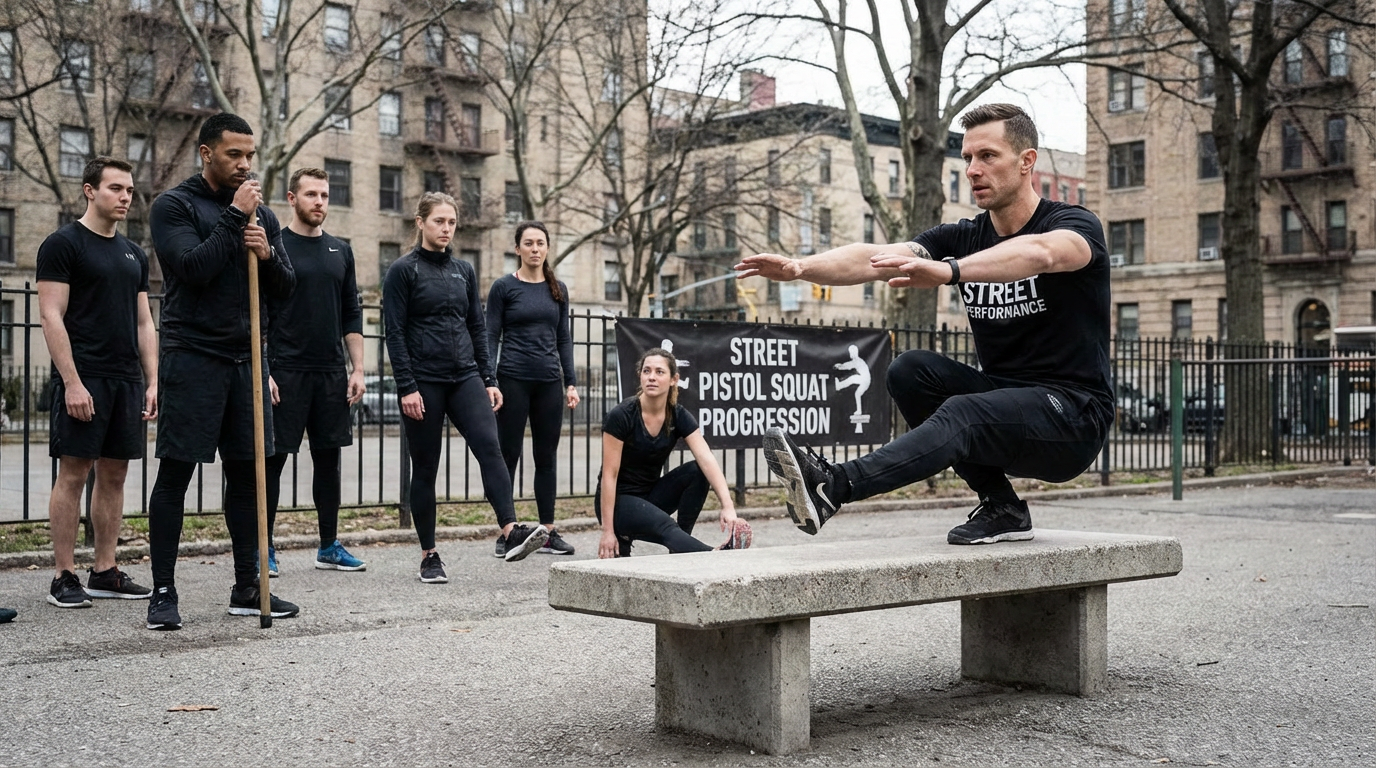
A pistol squat is a full single-leg squat: you stand on one leg, lower until your hamstring touches your calf (or close), then stand back up. The other leg stays off the ground—straight in front or to the side. It builds serious single-leg strength, balance, and mobility. You need no equipment; you can do it in the park, at home, or on the street. This guide walks you through a clear progression from assisted to full pistol so you can get your first rep and then add volume.
Prerequisites
You need a solid two-legged squat—at least 10–15 bodyweight squats to depth (hip crease at or below knee) with good form. Ankle and hip mobility matter: you need enough dorsiflexion and hip flexion to get deep on one leg. If you can''t squat deep on two legs yet, work on that first. Healthy knee and hip on the working leg; if you have pain, fix it before loading pistol volume. Some balance helps; we''ll build it in the progression.
Progression 1: Assisted Pistol (Hold Something)
Hold a pole, TRX strap, door frame, or band for balance and a bit of help. Stand on one leg, other leg straight in front. Squat down as deep as you can while holding the support; stand back up. 3×5–8 per leg. Use the support to stay balanced and to pull a little if you need help at the bottom. Focus on keeping the standing knee in line with the toe and the chest up. As you get stronger, use the support less—lighter grip, or one finger. Build to 3×8 per leg with minimal assist before moving on.
Progression 2: Elevated Pistol (Heel on Box or Slope)
Stand on a low box, step, or slope so the heel of your standing foot is slightly elevated. This reduces the demand on ankle dorsiflexion and makes the bottom position easier. Do pistols (or assisted pistols) from here. 3×5–8 per leg. Once you can do 3×6–8 with minimal assist, try lowering the elevation or moving to flat ground with support.
Progression 3: Counterbalance (Weight in Front)
Hold a light weight (plate, kettlebell, bottle) in front of your chest with both hands. This shifts your center of mass forward and helps you stay balanced and get deeper. Do pistols with the counterbalance; 3×5–8 per leg. As you improve, use a lighter weight or no weight. This teaches the movement pattern and builds confidence.
Progression 4: Full Pistol (No Assist)
Full pistol: no support, no elevation, optional counterbalance (or none). Stand on one leg, other leg straight in front (or slightly to the side if that''s easier). Lower under control until hamstring touches calf (or as deep as you can), then stand up. 3×3–6 per leg to start. Keep the standing knee in line with the toe; don''t let it cave in. Drive through the whole foot. Extend the free leg so it doesn''t touch the ground. One clean rep per leg is the first goal; then add reps and sets.
Balance and the Free Leg
The free leg (the one not standing) acts as a counterbalance. Keep it straight and in front (or to the side); point the toe. The more you extend it and keep it off the ground, the more it helps balance and the harder the squat. If you struggle with balance, practice holds at different depths—hold at the bottom of an assisted pistol for 5–10 seconds. Single-leg stands and single-leg RDLs also build balance and stability.
Mobility Work
Ankle dorsiflexion: stretch the calf, do ankle circles, and practice deep squats with the heel down. Hip flexor and quad flexibility: stretch the hip flexors of the standing leg and the quad of the free leg (it goes behind you at the bottom). Spend 2–3 minutes before or after your pistol work on these. If mobility is the main limiter, add a dedicated mobility session 2–3 times per week.
Common Mistakes
Knee caving in—push the knee out over the toe; think "knee tracks toe." Rounding the lower back—keep the chest up and core tight; go only as deep as you can with a neutral spine. Not going deep enough—use elevation or counterbalance to get deeper, then wean off. Rushing the descent—control the way down; speed can come later. Training only one leg—always train both legs for balance and symmetry.
Programming
Train pistol 2–3 times per week. Do it when you''re fresh—after warm-up, before or after other leg work. 3–4 sets of 3–6 reps per leg (or assisted reps) with 60–90 sec rest. Once you have 3×5–6 per leg full pistol, you can add volume (e.g. 4×6), add weight (goblet pistol, pistol with weight in front), or work on shrimp squats or other single-leg progressions. Don''t do high-rep pistol sets until you''re very comfortable; the knee and hip take a lot of load.
Summary
- Progressions: Assisted (hold something) → elevated heel → counterbalance → full. Build reps (e.g. 3×8 assisted) before moving on.
- Balance: Free leg straight and in front; practice holds at depth; use counterbalance to learn.
- Mobility: Ankle dorsiflexion and hip flexor/quad flexibility; stretch and practice deep squats.
- Cues: Knee over toe, chest up, drive through whole foot, control the descent.
- Volume: 2–3× per week, 3–4 sets per leg; add weight or harder progressions once you have 3×5–6 full.
Pistol squat is a benchmark single-leg move. Nail the progressions, work on mobility and balance, and stay consistent—you''ll get there.